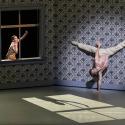
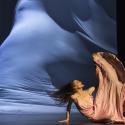
Rambert is making a thing of acquiring classic works from the 20th-century contemporary repertory – and a very good thing, too. First staged by them last year, RainForest, a minor Merce Cunningham piece from 1968, was recently performed by the Cunningham company itself, in London on its final tour. And yet, while that performance was straight from the horse’s mouth, I think Rambert (whisper it) in reality do it better.
This is partly because they don’t have the Cunningham neutrality down pat. Cunningham’s dancers were trained to be affectless, to perform as cogs in the Cunningham machine. Rambert’s dancers, by contrast, are trained to be expressive, to communicate not merely with their bodies, but with their minds. Thus this fairly programmatic work, a collage of jungle sounds, jungle movements, dappled light and feral darting shapes, is here given new force and explanation by these dancers’ inability to hold back, to refuse to share their understanding with the audience.
Asking dancers to speak is usually neither sensible nor kind – in this case, both
The shape of the Sadler’s Wells proscenium stage, too, works better than the Barbican, where the Cunningham company appeared: Andy Warhol’s helium-filled Silver Clouds here scud serenely across the floor, driven by the dancers’ movements, rather than making a break for the audience, as they did at the Barbican, ending up in the pit, or being wrestled to the ground in the auditorium by ushers-turned-balloon-wranglers (which was entertainment, but not as Merce would have had it). Here the show is all on stage, with fine, focused dancing from all, and a performance of particular driven ferocity from the always splendid Pieter Symonds.
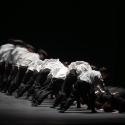
 That, however, was the high point of the evening. Mark Baldwin’s new Seven For A Secret promises much in the programme, but the interest remains stuck firmly on the page. (Pictured right: Dane Hurst, photo Hugo Glendinning.) Baldwin has worked with Nicola Clayton, Professor of Comparative Cognition at Cambridge, who writes fascinatingly of how children perceive the world entirely differently from adults: remembering differently, thinking differently, seeing their place in the world differently. Yet somehow the result is standard kid-kitsch, a collection of stereotypical children playing stereotypical games. (They are even stereotypically gendered, with girly girls and butch boys.) Unlike Hush, Christopher Bruce’s touching meditation on youth and ageing, Seven for a secret has nothing new to tell us, and it does so at great length.
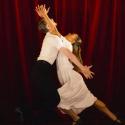
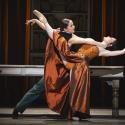
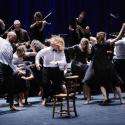
 Javier de Frutos’s Elysian Fields similarly takes a very long time (the entire programme lasts nearly three hours) to tell us very little, and that little very superficially. (Pictured left: Pieter Symonds, Gemma Nixon and Jonathan Goddard; photo Gavin Evans.) It is “inspired” by the works of Tennessee Williams, which basically means a mash-up of snatches of text and dabs at characters, who sit in vaguely Mooresque-looking chairs of differing, Alice-in-Wonderland proportions (designed by Katrina Lindsay), around a circle where the action takes place. Asking dancers to speak is usually neither sensible nor kind – in this case, both: the accents veer from standard UK RP to phoney Southern Gothic (it took me a while to realise that when something was “Fayed” it wasn’t Mohammed that was being referred to, but a gun), while they often must speak after a spate of frantic clutch-and-grope choreography, so the words are lost in the gasping.
None of the characters are differentiated, so there is no sense of even Williams’s melodrama. This is middle-brow entertainment masquerading as high art – which is, now I think about it, a pretty good description of Tennessee Williams, too.
- Rambert Dance Company is at Sadler's Wells until 19 November, and then on tour to Bradford, Plymouth, Newcastle, Aberdeen, Mold, Canterbury and Brighton