“Over the top” is a curious expression. Originating in World War One, to mean going over the edge of a trench and into battle, it has altered by degrees to mean anything extravagant or outrageous. And Gloria, which is arguably Kenneth MacMillan’s masterpiece, has both the literal and figurative meanings of going over the top layered upon each other.
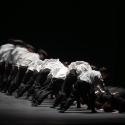
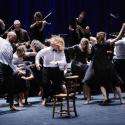
The spare, terse set by Andy Klunder, a skeletal structure in front of a small slope, in sere, dying yellows and dried-blood reds, gives us our no-man’s-land, where soldiers (the Tommy’s tin hat is the only indication of occupation or period) appear, one by one from the trench at the back of the stage. In among them dart and flicker grey-skirted, grey-faced women, angels of death, both comforting the men and leading them to their deaths. It is MacMillan’s triumph to have seen in Poulenc’s odd, quirky, flickering brightness the horror and tragedy of a generation as these avatars of death go busily about their business.
 Carlos Acosta (pictured right, photo: Dee Conway) and Thiago Soares were the two soldiers, with Sarah Lamb their angel. Soares’s rusty, bloodied shapes were compelling; Acosta only slightly less so in that his body falls so naturally into a pure classical line that he sometimes failed to achieve MacMillan’s tormented poses.
Edward Watson has, in the past, used his hyper-extended arms to create a compelling picture in this piece, but in this programme was instead a more restrained, and touching, Arthur Troyte Griffith in Ashton’s Enigma Variations, the centrepiece of the evening. Enigma is a problem piece, with superficially only Edwardian fustiness, and nothing to say to a modern audience.
But this would be to underestimate both it and Ashton. Today, in a culture that welcomes emotional incontinence, there is something pleasurable in an act of withholding, of discretion. The core of the piece is in the pas de trois between the composer Edward Elgar (Christopher Saunders), his friend, Jaeger (Bennet Gartside) and Elgar’s wife (Christina Arestis). Ashton pared away the steps until only vestigial gestures remained, indications of a yearning and desire for which his characters have no words. Yet it is in their inability to express their emotions that the strength of the piece lies, as Ashton mirrors the way the lush Romanticism of Elgar’s orchestration contrasts with its austere structure, a series of formal variations.
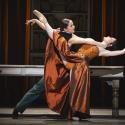
 In the trio’s single raised-arm gesture, as the crescendo rises, they encompass love and loss, loneliness and friendship – loneliness in friendship, a desire for what isn’t there matched by gratitude for what is. These are complex, and very grown-up emotions. It is not easy, always, to discern them under Julia Trevelyan Oman’s now dusty-feeling sets, but, in particular, Gartside (pictured left, as William Meath Baker, in the same ballet, photo: Dee Conway) and Arestis have the ability to say much with the bare minimum. A very English talent.
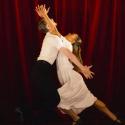
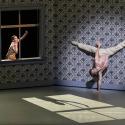
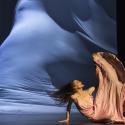
Neither of these pieces are easy to programme with their harrowing and glancing emotionalism. Liam Scarlett’s Asphodel Meadows seems to have been selected because of choice of music (Poulenc’s Double Piano Concerto, making the evening a Poulenc sandwich) and its reference, too, to the dead. The Plains of Asphodel were, in the Odyssey, the place in Hades for those dead who did not reach the Elysian Fields, left there to repeat endlessly after death their lives as they had been lived above ground. Scarlett, only 24 when this piece premiered last year, has created an astonishingly efficient and workmanlike piece for three couples, whose pas de deux emotionally recapitulate their above-ground situations. The puckish, darting music is, in particular, well suited to Marianela Nuñez (main photo above), fleet and sleek, and Tamara Rojo, who purrs through her section like the well-oiled Rolls-Royce she is.
Yet this work, despite its title and its elegant black-and-white set, immaculately conceived by John MacFarlane, is really a piece of Neo-Classical abstraction. Emotions have little sway here, and there is certainly none of the pity and terror of Gloria. There, in the great culminating pas de trois, the two soldiers and death herself point accusingly at us, the audience. It is our fault that they are dying. And then the accusation is over. MacMillan makes the moment more terrible for being so brief. It is done, and the men walk stoically off, each one turning and looking back, back at life, back at us, and then resuming his way, to his duty, to his death.
- in repertory at the Royal Opera House until 30 November
Watch an extract from Gloria