Let us conclude, after London’s season of World Cities - 10 dance shows - that Pina Bausch was not a choreographer. She began 50 years ago in Essen as a ballet dancer and like so many dancers in that field got bored with the rules. When she took over ballet in Wuppertal in 1973, she clearly had rule-breaking in mind but also had something inside her head very different from what one might identify as the geometry of dance.
She is undoubtedly a stage poet, in my view more Surrealist than Expressionist - striving in a genuinely theatrical way to fulfil Marianne Moore’s advice that poets should attempt to build “imaginary gardens with real toads in them”. Early Bausch works such as The Rite of Spring and Café Müller are fraught with conflict and melancholy, and in a more or less conventional sense choreographically designed, especially her Rite. Should arguments to support her later works collapse, that will remain her masterpiece. Doubts, alas, begin with Bausch’s attempt to internationalise her shows, to fertilise them with the imagery and, it has to be said, the clichés of cultures seemingly a very long way from the inside of her head.
As this bold, month-long piece of programming at Sadler’s Wells and the Barbican shows, everything that’s different is roughly the same. On stage people come and people go; there’s lots of water, lots of smoking, lots of high heels, lots of things wished for and spoken out loud by adults with the insouciance of children, and lots of solos by lithe and beautiful performers which, however, say little. She borrows from foreign cultures but never explores them. She is unteleological.
A man vigorously rubs a woman’s breast while she gulps milk from a bottle
The last show in the sequence was created with Central Europe, specifically Hungary, in mind. Wiesenland (meaning something like “state of meadows”: the French, by whom Bausch is much treasured, translate it as “terre verte”, green earth), is on balance one of the tenderest and now a personal favourite of mine; but that’s to state only a position of subjectivity. Bausch is all about personal favourites. One person's Nefés (Turkey) is another person’s Bamboo Blues (India); one person’s Ten Chi (Japan) is another’s Nur Du (Los Angeles). If there’s an overriding law to emerge from this global mishmash it is that Bausch archly defeats criticism.
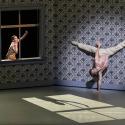
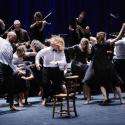
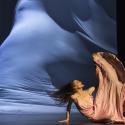
Against an enormous, vertical-standing backdrop of jungly vegetation, which leaks water, the ensemble enacts little dramas of desire and rejection. There are tropes of gypsy matrimony (the Romanian band Taraf de Haidouks, amongst others, are credited in the track listing), two wedding dresses tossed about in the air like ghostly shuttlecocks. Dancers, still smoking, are doused in water from buckets, perhaps in some ritual of barmy baptism - a return from striving adulthood to a cleansing innocence...?
In an extraordinary image a man vigorously rubs a woman’s breast while she gulps milk from a bottle. Wiesenland clearly evokes the good things of the human earth, fecundity, nature and nurture, without knowing (or wanting to know) where they’ll take us, or the performers. And as usual in Bausch no one actually gets it together. In a wonderfully humorous episode, a man and a woman wash each other, and try to go to bed - but she gets stuck in the metal bucket and he then knocks them both out with a roll of newspaper. Etc.
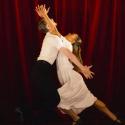
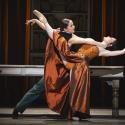
In the second half, with the meadow backdrop now horizontal, continued shenanigans - below it and on it. One moment of group work, couples dancing sweetly arm in arm, almost cheek to cheek, promises to turn into an achievement, something to lift us perhaps towards a climax after all the fragmentation, but it’s shortlived. Bausch is a tease, a frustrator, an original artist for sure who distrusts art: less choreographer than, as her legions of fans and the standing ovations night after night in London have proven, popular entertainer.
Wiesenland gallery: click on the images to enlarge