Björk’s Biophilia is a five-headed organism: the album (itself issued in five different editions), the app, the documentary, the live show and the website. Here in Harpa, Reykjavík’s spanking-new concert hall, Björk is in her home town, delivering the live show, performing the music. She’s playing residencies rather than touring. Instruments have been specially made. A giant spark arcs between two Tesla coils. Four massive pendulums swing.
Manchester’s Campfield Market Hall snagged the premiere in June, and now her residency in Reykjavík has begun. Last night – timed to coincide with the opening of the Iceland Airwaves Festival – was the first of nine Biophilia shows at Harpa. The last is on 3 November. All are sold out.
'With Biophilia comes a restless curiosity,' declares Sir David Attenborough
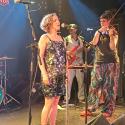
Of course, this is hardly a normal show. Biophilia is performed in the round, with Björk, her all-female choir and what might be normal instruments strewn along the lip of the dais. Those pipes could be part of an organ. The harpsichord looks standard issue.
It begins with the disembodied voice of Sir David Attenborough. “With Biophilia comes a restless curiosity,” he declares. “In Biophilia you will experience how the three come together: nature, music and technology.” Screens above the podium display the images accompanying Biophilia’s songs. It could be a lecture. In her massive orange wig Björk doesn’t say much, leaving the explanations to the disembodied voice. Before “Moon” it intones: “Moon. Lunar cycles. Sequences.”
All of Biophilia is given an outing. “Thunderbolt” kicks it off. Electrostatic energy jumps between two Tesla coils in symbiosis with the song’s rhythmic stabs. It’s a mind-blowing opening, distracting from Björk and her 24-strong chorale. But once it settles in, the combination of Björk’s see-sawing voice, the power of the choir and the melodies bring the album's songs a new warmth. “Virus” – with its footage of a cute green virus homing in on a cell – is less sparse, more alive than its studio counterpart. Older songs – “Mouth’s Cradle”, “Isobel” - shine in this setting.
The contrast between the virtual and the actual, the unseen and the physical isn’t apparent
But there’s more here than the music, more than Sir David Attenborough and more than the imagery on the screens. Matthew Herbert is stunning on percussion, but it’s impossible to be unaware of the instruments triggered digitally. A bank of four three-metre pendulums swing, plucking strings. The pipes of an organ are controlled remotely. Yet the union of the organic and digital doesn’t matter, it's what's heard that counts. During “Mutual Core” it’s Björk that hogs the eye, not the pendulums.
The contrast between the virtual and the actual, the unseen and the physical isn’t apparent. As you look at this Willy Wonka idea of what a stage show could be, it becomes clear that whatever the label on the package, it's the songs that are going to linger longest. No wonder she’s taking three years out to play these residencies.
Although the app is the most crucially now of Biophilia's quintet of sales platforms, messages generally outlive the medium – the music usually overshadows its means of delivery or whatever other stuff accompanies it. Sometimes – say, some Eighties videos - music and image become indivisible. But with rubbish music, the other stuff wouldn’t matter a jot. Based on last night, those without an iPad, iPhone or iPod touch needn’t fling themselves into the harbour alongside Harpa. There’s no need to rush out to an Apple store to get into Biophilia. Live, on an old-fashioned stage, it works just fine.
See the instruments specially made for Björk's Biophilia