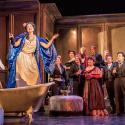
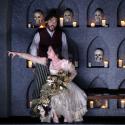
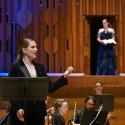
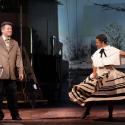
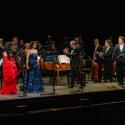
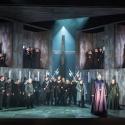
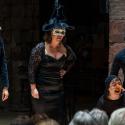
Graham Vick's Tamerlano is less of an opera and more of a warning. In four and half hours you see 26 ways of how not to handle the Baroque aria. Dramatic success in Handel and his psychological flights of mainly soliloquising fancy is never easy but last night's ill-fated Royal Opera House production (Placido Domingo called in sick a few weeks back) was a lesson in abject theatrical failure. Or actually 26 lessons (there are around 27 arias in all). First up in the Graham Vick how-not-to-illustrate-an-aria class: clog-dancing. Particularly not to be used as an opener, particularly not suited for genocidal tyrants in drag or for singers who, well, could sort of pass for clog-dancers.
Second way not to illustrate an aria: hyper-emoting in the manner of Celine Dion. Third: mining the sign-language of CBeebies. Fourth: using a Generation Game conveyor belt of blue elephants as a fun distraction. Fifth: avoid ornamental dancing Ottoman soldiers, unless you're working on a camp-off with the makers of The Graham Norton Show.
Sixth: steer clear of CBeebies sign-language in duet or trio form. Seventh: refrain from mounting singers on aforementioned elephants for comic or lavish effect. Eighth: avoid shoving the small, fine voice of Sara Mingardo (Andronico), the most musical singer in the cast, where no one can hear her. Ninth: don't revolve singers on giant turntables if completely and utterly and brainlessly unnecessary. Tenth: avoid any sort of sheet dance - yes, that's any dance involving the use of sheets, linen or otherwise.
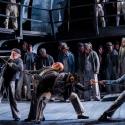
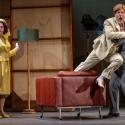
Eleventh: if a character feels lost, try to think of something a bit better than having them ape a blind man. Twelfth: don't then force all the dancing Ottoman janissaries to go blind too. Thirteenth: Monty Python's giant foot, which Vick resurrects as a political swingometer (above), is not a very sophisticated metaphor for the fluctuations of tyrannical power. You get the picture. That was how the first two acts unfolded: as a collection of out-and-out missteps and befuddling oddities.
It's not even as if Tamerlano has one of those bafflingly baroque, Baroque librettos. At its core are two fascinating and eminently updatable concepts - the love of power and the power of love - and a string of pearly arias. To do so little dramatic driving or narrative sculpting of these, not to pick up on, or intelligently tease out, the numerous psychological twists and turns that are there in the musical and dramatic terrain, to summon up instead neither an accurately real, nor interestingly surreal, minimalist world, effete and ill-defined, is a serious failure of duty.
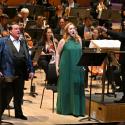
As was much of the singing. Most noticeable was Christianne Stotijn (playing Tamerlano the clog dancer), whose ravaged voice had almost split in two, and an out-of-tune Christine Schäfer (Asteria). Only Renata Prokupić's Irene had the requisite ability to control and project with real satisfaction. Kurt Streit (Domingo's replacement as Bajazet) seemed to coast a little at the start but then flowered both in character and in voice in the Third Act.
The Third Act, in fact, saw the whole production, the whole cast and orchestra, in the best form of the evening. As the drama closed in on the six characters, the mood blackening, the psychological relations spinning into extremity, so Vick was forced to start to focus his mind on the topic of human interaction without recourse to mindless frippery. Tenderness, intensity and a forward-spinning dynamic all suddenly started to bubble up to the surface as the singers began to work in ensemble. The singing tightened up. Ivor Bolton's conducting of the Orchestra of the Age of Enlightenment, lacking the necessary bass welly in the first two acts, unleashed some ravishing melancholic playing and then, in the final quartet, skipped into the gentlest, most sunnily winning of dances. But after four-and-a-half long hours, it was far too little, far too late.
- Book for Tamerlano at the Royal Opera House.
- Check out the rest of the Royal Opera House season.