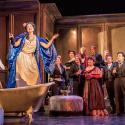
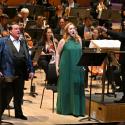
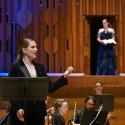
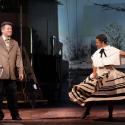
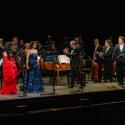
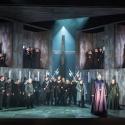
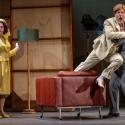
Everyone concerned has, of course, total confidence and bags of experience at the end of a riotous run, warmly applauded by Edward Seckerson at Glyndebourne. Yet there were dangers to be negotiated. Only Irmgard Vilsmaier's Sieglinde-cum-Fricka of a mother and the ringing top of Alice Coote's Hansel as tough boy incarnate were really made to fill the crazy South Ken colosseum. The secret for the rest, and I'm sure Ticciati in his Proms debut must have worked on this, was not to force but rather to draw and coax us into Humperdinck's often startling late-Romantic clash of innocence, experience and something altogether darker, violent even.
It must have been a curious liberation for the London Philharmonic Orchestra, playing more ravishingly and buoyantly than I've ever heard them, even under Jurowski (another great interpreter of this score). Ticciati's pliancy and his achingly beautiful phrasing let the score break luminously free of any post-Wagnerian excesses or pastiche - sometimes dreaming, sometimes tripping wide-eyed into the seemingly naive folkloric world inhabited by the young Mahler.
Transitions were fluently judged, from the gurgle of clarinets into the famous dance scene, so deft and bright-eyed, and on to the shocking thud of mother's return. Pregnant pauses have become a Ticciati speciality. And the transfer made the most of the spatial effects which are the hall's biggest bonus. Father - a musicianly if not ideally bass-baritonal William Dazeley - slouched on in tracksuit bottoms and ponytail with his plastic bags from the back of the arena, clambering and slumping over rails to reach his cardboard home. Just a bit of fun, you might think, except that through all the built-in hesitations and tempo-changes of his song, he remained perfectly at one with Ticciati and the orchestra. The cuckoo and the echoes of children's voices in the dark woods were magically placed, bringing tears to the eyes along with the silky strings and pianissimo voices of Coote and Lydia Teuscher's ideally spirited Gretel in the Evening Prayer - two small children lost in the vasts of the Proms' Gargantuan maw.
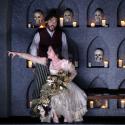
The visual coup of Pelly's production, which helped to make sense of the first two acts' cardboard home and litter-strewn forest, was his supermarket witch's house, opening its chocolate-box walls to reveal serried rows of knives: a supreme invention by designer Barbara de Limburg Stirum. Here the props department had worked overtime to come up with the evening's best gag - an equally gaudy mini Albert Hall.
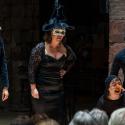
Performance of the year in which I first saw the Glyndebourne production came from character tenor Wolfgang Ablinger-Sperrhacke as a witch in pink twinset and pearls, swooning at first to Ticciati's proto-Rosenkavalierish waltzes (let's not forget Richard Strauss conducted the 1893 premiere, and even stole the terrified trills introducing the Sandman for Salome's fatal request). From my distant seat Ablinger-Sperrhacke's characterisation lost something in terms of creepy finer nuances, but he knows how to work a crowd, and proved repellent enough in revealing bra and prosthetic hairy belly to send one indignant bow-tied gentleman stomping from the hall.
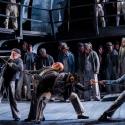
No room on the raised strip of stage at the back of the Albert Hall platform for a scary gas oven, only a cardboard cooker into which the Witch is shoved before making a slow exit, box on head. One more visual idea remains: the rows of children whom we've seen in white in the Dream Pantomime now fat-suited and wan coming back from gingerbread limbo. As at Glyndebourne, the onlookers laughed for a moment and then took their sorry state very seriously. With Ticciati guiding their high spirits, the happy end was suitably rumbustious. And never mind the bah-humbug chap repelled by a bit of fat and hairy flesh; the kids in the audience came out thrilled to bits.
- Find out about Glyndebourne on Tour, starting in October
- Read theartsdesk's recommendation's for the 2010 BBC Proms
- Full listings for the 2010 BBC Proms
- Listen to this Prom on the BBC iPlayer for the next six days
Watch Wolfgang Ablinger-Sperrhacke's Witch in action in the original Glyndebourne staging by Laurent Pelly (YouTube):