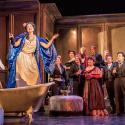
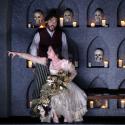
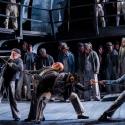
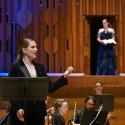
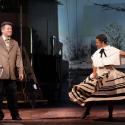
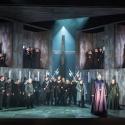
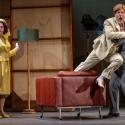
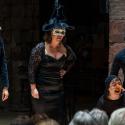
Here we go again. Art takes on capitalism, round 4,598,756. The blissful life of Harry Joy, ad exec extraordinaire, beloved father of two, is (surprise, surprise) not quite what it seems. His wife is having an affair, his daughter is fellating his son for drugs and his business clients are spreading cancer. He thinks he's in hell. But this ain't hell; it's the greedy, bourgeois reality of a capitalist West. Stalin would have been mighty proud of Australian Brett Dean's new opera, Bliss, which was receiving its European premiere at the Edinburgh International Festival.
Having said that, Stalin would have been less proud of Dean's fantastically degenerate music and would probably have set Zhdanov onto him. Bliss swims in an unashamedly neo-Modernist sea, one that is littered with helpful lifebuoys, rhythmic insistency, catchiness, repetition, lyricism and Hindemithian counterpoint (though I could just have Hindemith on the brain after last Wednesday night), that always make the score nothing less than sympathetic and often much more than this.
Dean's greatest virtuosity is in the field of orchestration (which his time as a violist in the Berlin Phil under Karajan must have informed), which is replete with clever little jokes - like the wah-wah-ed phone call. Yet it's a virtuosity that doesn't always carry through to other aspects of his composing. A lyrical and harmonic flat-footedness, for example, is to be found in Act Three that reveals an unfamiliarity with the art form (it is his first opera) and indicates where this real talents lie: in orchestral composition. But the accessibility and memorability of the music is impressive and brave. Dean is never afraid to summon up or absorb the sounds of the streets, whether those be electronic, rock or jazz.
It's an accessibility that has a flip side, however, an ingratiating side, which comes out most irritatingly within the plot. Whether (to be charitable) as a result of convenience and economy or just (as is my hunch) as the result of a subconscious bien pensant-ary from librettist Amanda Holden, the opera doesn't really spend much time giving very realistic reasons why or how advertising (and the businesses Joy's ad company represents) are so very horrific, almost as if Holden is presuming (or hoping) that a Leftist consensus among the audience would flesh out the back story. And if and when Dean and Holden do try to give reasons for the horrors of the modern world, they do so so crudely and absurdly - such as when claiming that petrol is evil - that the whole thing descends into agitprop.
The book by Peter Carey on which this work is based is, perhaps inevitably, much more subtle than this. Partly because every sentence is so beautifully turned out. Most of Holden's dialogue is less impressive, though it is uniformly excellently sung, and often (though not often enough for me) with an Australian drawl. The high came from Henry Choo, who plays the simple-minded maître d', Aldo, as well as Nigel Clunes, the head of a firm that is selling cancer-causing products, and from Joy's son, David Corcoran, who had an impressively volatile way with his voice. The low was Peter Coleman-Wright's Harry, not unstable enough for a man enduring an earth-shattering mid-life crisis.
So, with perfectly adequate conducting from Elgar Howarth in the pit, the only real star of the show came from the set designer, Brian Thomson, whose ingenious box of pixelated light bulbs was so brilliant it almost made up for the other idiocies. The worst of which was the presumptive bandying about of the idea that a high preponderance of cancer in the West was an indication of a profoundly unhealthy society. Nothing could be further from the truth. As the biochemist friend I was with explained to me, high cancer rates are in fact a sign of a society in damn good nick, a society that has eradicated so many of nature's diseases that there is nothing left to kill us but random genetic mutation.
Bliss isn't the best opera to go to with anyone who knows anything about the real world.
- Find out more about Opera Australia
- Find out more about Brett Dean
- Buy Peter Carey's debut novel Bliss on Amazon