Such a pity about Beatrice and Benedict! As a musical visualiser, a creator of musical tableaux, a radio composer avant la lettre, Berlioz had few equals. The Damnation of Faust is surely the greatest radio opera ever written. But for some reason he had no grasp of the stage. Benvenuto Cellini is a lifeless succession of spectacular tableaux. The Trojans must have more superb music per square yard of ineffective drama than any work of comparable length.
As for Berlioz’s singing-telegram version of Much Ado About Nothing, it would have merited that title all too well if Berlioz had risked it. As it is, the one he chose tells us precisely what the work is not about, which I suppose is a triumph of sorts. The real heroine is, aptly enough, Hero. She has the biggest solo and the major part in the two big female ensembles. Yet her lover, Claudio (almost her sole topic of conversation) sings nothing except a small part in one trio, and is otherwise passive or absent.
Berlioz called the work a caprice written with the point of a needle, but it needs playing of equivalent refinement
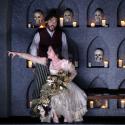
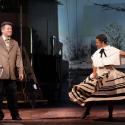
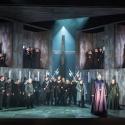
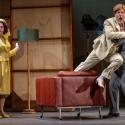
The nominal hero and heroine discover and discuss their love in spoken dialogue, and have nothing approaching a love duet. Beatrice hardly sings in Act 1, Benedict hardly in Act 2. And so on. Almost every dramatic (as opposed to musical) decision is a mistake. Somehow WNO’s revival of their now quite antiquated Elijah Moshinsky production gets round this with a lovely, exquisitely lit Renaissance-arcade set by Michael Yeargan (lighting by Howard Harrison), some witty stage business, especially for the musician Somarone (brilliantly farced up by Donald Maxwell), and well-posed tableaux vivants, which accept the beauty of Berlioz’s inspiration while acknowledging his dramaturgic frailty.
WNO do make some mistakes of their own, it’s true. I can see why they play Beatrice in Geoffrey Dunn’s skilful English, not least for the jokes; but the invitation to regret the absence of Shakespeare’s sparkling barrage of repartee in the presence of odd fragments of it is altogether too glaring. Much better, surely, go French and hang the comprehension (Maxwell, at least, would be funny in any language).
 But the main risks are musical ones, and not all of them come off. Somarone’s send-up of a bad village choir, wonderfully exaggerated, and perhaps too well corrected second time through, is a little near the bone when the pit orchestra also has its rough patches of wind intonation and the stage choir, usually peerless with this company, has moments of untypical coarseness. Berlioz called this last opera of his “a caprice written with the point of a needle”, but it needs playing of equivalent refinement. Here, under Michael Hofstetter, the needle-point is blunted by careless balance, with high woodwind and brass stepping too enthusiastically into the spotlight. On the other hand, Hofstetter’s pacing of music so quicksilver subtle in its movement and texture is mostly excellent: not his fault that every five minutes or so the music has to stop at the traffic lights of stodgy, semi-Shakespearean dialogue.
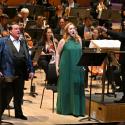
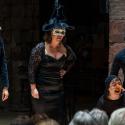
The cast looks strong on paper, sometimes struggles with Berlioz’s gaucheries in practice. Laura Mitchell (pictured above) has moments of real splendour in Hero’s extraordinary Act 1 aria with its huge written-out cadenza (what did Berlioz think he was writing?), and the poised beauty of her “Nuit paisible et sereine!” duet with the dark-toned Ursula of Anna Burford ends the act on a high musical note, though at times, in this big arena, the voice forces a touch and perhaps lacks the last measure of warmth.
Sara Fulgoni’s Beatrice – repeated, as she may not care to be reminded, from the original production of 1994 – is commanding when Berlioz allows, which is essentially only once, in her lovely second act aria, a Gluckian scena that has precious little to do with the character but is incomparable as a set piece.
Robin Tritschler’s lank-haired Benedict – allegedly but inaudibly becolded on the first night – has a lovely delicacy of tone and mobility, but lacks snap to go with a character who, until his too easy conversion to sentimental lover, is all crackle. No one else gets much chance to sing anything worthwhile, but they all have a go at talking what amounts to badly remembered Shakespeare. Not surprisingly, the success rate varies.
- Beatrice and Benedict at the Wales Millennium Centre on 26 Feb then touring