“Now go we in content. To liberty and not to banishment.” A touchstone to productions of As You Like It, Celia’s wishful recasting of the Forest of Arden can rarely pass unchallenged by directors. In 2009 we saw Michael Boyd’s RSC production go head to head with Thea Sharrock’s unexpected and beguilingly sunny interpretation at the Globe – a contest in which Sharrock proved a comfortable victor. Returning once again with his conventionally darker-hued take on Shakespeare’s comedy, the question was always going to be whether Boyd could grasp the authority that so slimly eluded him last time.
While there is plenty of fun to be had on the way to a conclusion (not to mention sound lessons to be learned about enclosure and Elizabethan politics) the answer remains in the negative. There is much of the adolescent about As You Like It. Pivoting from frothy sex-comedy to themes of ambition, fratricide and social injustice, the play’s awkward tensions give it its character as well as its rather uncertain charm. In attempting to marry these two registers coherently Boyd has inadvertently blunted the comedy and neutered the violence. Albeit very stylishly.
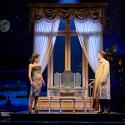
We open in the colour-drained world of the usurping Duke’s court. Faces are painted as white as the set, clothes uniformly black, and the only blot comes from a strategic blood smear, deposited during the rather vehement wrestling match. In a neat piece of design from Tom Piper, the white panels of the court gradually open to reveal the straw-spilling world of the forest, an altogether messier and less unified space.
 As we unbutton from the stiff choreography of court life – rhythmic rituals of movement from Struan Leslie make an elegant point – so both costumes and speech relax also. Elizabethan ruffs and corsets give way to bare feet and even trainers and denim. It’s a shift whose gentle pace prevents it feeling too contrived, and is balanced by a growing irreverence in the language; accents deviate, and anachronism abounds. One of Boyd’s greatest successes here is his irreverent freedom with the text, playfully colonising gaps within it, or creating spaces where they fail to exist.
Returning as cross-dressing heroine Rosalind, Katy Stephens (pictured above) is as long-limbed as she is lovesick – endlessly watchable and entirely charming. Yet it is only really as Ganymede that things settle. The early scenes at court are blighted by a not entirely deliberate stiffness, particularly present in the private moments between Rosalind and Celia, setting an uneven tone to their friendship that is never fully resolved. Mariah Gale’s Celia, rather less pert and much less passive than the usual ringleted lovely, benefits from Gale’s trademark ferocity. Her restless struggle with Rosalind’s romance is neatly observed, but not even she can redeem the hasty union with the awful Oliver.
 A strung-out rockstar manqué, Forbes Masson’s Jaques makes quite the entrance with a falsetto bit of power-balladry, Shakespeare style. All wild hair and eyes, his claim, “I can suck melancholy out of a song as a weasel sucks eggs”, is amply borne out in various abortive musical numbers. Yet with the memory of Tim McMullan’s extraordinary Jaques still lurking in the ears it is hard to feel entirely satisfied with this easy comedy. The decision to abandon court for a life of religious seclusion is surely (far from a token resolution) one whose origins must be evident from the start if the character is to succeed, to darken the substance and not just the tone of the play.
An adequate Orlando from Jonjo O’Neill and pleasingly modern Touchstone from Richard Katz round out the major players, but confusion reigns among supporting roles. Martext (James Traherne, reduced to a footnote) is a surreal cipher, and neither Phoebe nor Audrey (Christine Entwisle, Sophie Russell) achieve anything like the comedic warmth their lines invite.
Much has been made of the beheading and skinning of a rabbit that takes place onstage. Yet as a metaphor for the show’s more sombre elements it fails. This As You Like It is not the cleanly flayed, committed gesture Corin (Geoffrey Freshwater) so stolidly performs. It vacillates, threatens violence while brandishing only a rubber knife. No “golden world” this, but no desert of exile either – Boyd’s production is good enough, a second-best production of Shakespeare's somewhat second-best comedy.
- As You Like It is at the Roundhouse until 5 February
- See what’s on at the RSC this year
- Find As You Like It on Amazon