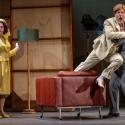
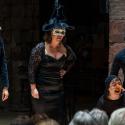
Dragon Opera (or Opera’r Ddraig, if you insist: they don’t) is in every sense a young company, founded a mere two years ago, and based at Cardiff’s Royal Welsh College of Music and Drama. Its singers, directors and orchestral players are nearly all recent or current students at the college, the company is run by recent graduates, and its funding is set up by a student collective called RepCo, run from the RWCMD, and parent also to a couple of student orchestras and a community choir.
Even the audience is, for once, not the usual gathering of senior citizens. In terms of arts enterprise, this must be virtually a unique concept, but it might well serve as a model for others in the glorious age of the Big Society; to judge, at least, from the quality and enthusiasm of this Marriage of Figaro, it certainly works.
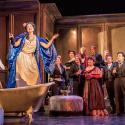
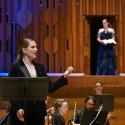
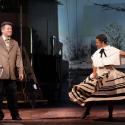
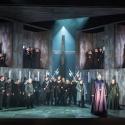
This is the company’s second production, after their Magic Flute a year ago, and anyone who knows about singing will know that starting with Mozart – whatever appearances may say – is going in at the deep end. To change the image, you can’t hide in Mozart and you can’t dither. Yet this Figaro, directed by Deborah Cohen and with economical – supposedly 1940s – designs by Steve Denton, sparkled from start to finish, moved briskly and purposefully, and was on the whole very well - and in one or two cases brilliantly - sung.
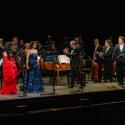
The Gate, a converted Presbyterian Church in the Cardiff suburbs, is an attractive, comfortable venue. But for opera it does present certain problems. Laid out as an arena, with audience on three sides and orchestra on the fourth, it provides intimacy but sometimes troublesome balance, especially for young singers not yet entirely secure in their production or range. Alasdair Cowie-Fraser conducted a strong, well-prepared performance, with few alarms and many fine touches, but he didn’t always turn the volume down quite enough, and some detail inevitably went missing, including, occasionally, the (uncredited) English text – as if keeping track of da Ponte’s fake assignations and lost pins wasn’t already quite enough of a challenge.
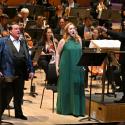
All the same, the young voices came through well enough to make condescension unnecessary. Singling out graduate singers can be an invidious process (not least when, as here, the production is double-cast); but in this case there was little agony. In particular Siân Winstanley was a fine Countess, with a lovely top to her voice and a touching, dignified stage presence; Timothy Nelson was a vocally impressive Almaviva, superb in his big aria (with a ringing top F sharp), if a somewhat wooden actor – or was he deliberately staged as a stiffly suited ministerial figure, bad with his hands except when there are girls around?
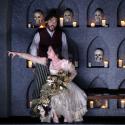
I also hugely enjoyed Llio Evans’s witty, slightly coarse-grained Susanna, stylishly sung, and Robert Garland’s personable, musicianly Figaro, though his bass register naturally needs more time (he was spared his rage aria in Act Four). Holly-Anna Lloyd sang Barbarina’s little lament exquisitely; Annie Sheen (also the company’s administrator) was an eye-catching, uninhibited, soprano-ish Cherubino, with a provocative sense of what it’s like to be a girl dressed as a boy dressed as a girl, and a slight tendency to sing sharp. Jan Capinski delivered Bartolo’s revenge aria with superb venom; he will surely be an outstanding Almaviva in the second cast. Shoshana Pavett (Marcellina), Eleias Roberts (Basilio) and Richard Moore (Antonio the gardener – a talented comic actor barely out of school) provided strong support.
- The Marriage of Figaro at The Gate, Cardiff on 3,4 and 5 February
- See what else is on at The Gate