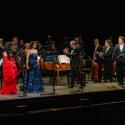
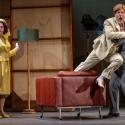
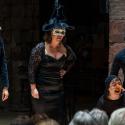
"Ne me touchez pas! Ne me touchez pas!" Mélisande's jittery first words could be the motto for the whole of Pelléas et Mélisande. How to touch, what to touch, when to and when not to touch, more specifically, how to mark without bruising, are the subjects and challenges thrown up by Debussy's delicate piece of operatic symbolism. Ones that all the artists in last night's concert performance at the Barbican Hall tackled with incredible levels of musicality.
There wasn't just an extraordinary sensitivity to the delicacies of this miraculous score. There was an honouring of the essential underlying principle of Debussy's work, which is the idea that, if you want something said, don't say it. This is why the opera is so devoid of what might be thought of as classically significant events and so full of what should be throwaway asides. The music and narrative are focused on revealing the dramatic potential of omission.
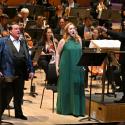
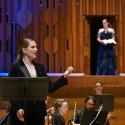
Natalie Dessay seems to know this well. She never indulged Mélisande's words or her presence. But neither did she leave any timbral stone unturned. Every "Je suis heureuse", "Je suis triste", "Ou?" and "Oui" was both rich in colouristic meaning and delivered effortlessly. Less was more in manner, too. Mélisande's rawness was played not through any banshee-like wildness but through the most intensely absorbing stillness one could imagine.
Some saw dramatic fault in this; Dessay was too wedded to her score, they insisted. I found it mesmerising. Her immobility, her blank stare, her fixed terror, seemed a perfect reflection of the consequences of the abuse that her poor Mélisande undergoes and has no doubt undergone before we find her lost in the forests.
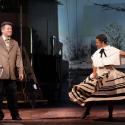
Simon Keenlyside's Pelléas shows Mélisande a way out, a way to live and flourish, through an embrace of play and sensual touch. It was an exquisite performance. No other singer of his age could so thrillingly or convincingly reconfigure themselves to the impulsive swings of a boy. Mélisande's voice, learning new intimate tricks in Pelléas's company, suggests a reversal of fortunes is in the offing. But her husband Golaud (impeccably sung and acted by Laurent Naouri) and his bruisingly abusing hands refuses to let her go.
All the smaller roles had their attractions, from Khatouna Gadelia's fresh Yniold to Marie-Nicole Lemieux's anxious Genevieve. Young Nahuel di Pierro's bass contribution as the Doctor was memorable. Alain Vernhes's Arkel, though appropriatly forlorn, was the only disappointment in his slightly lame delivery of the heartbreaking final lines. But mostly everyone dealt with their many emotional and musical delicacies with great skill.
They were no doubt taking their cue from conductor Louis Langrée and the Orchestre de Paris, all of whom were restlessly skimming the surface and never allowing themselves to bed down. Their approach led to one very strange conclusion. Of the many baffling things about this eternally baffling work the most baffling is the idea that the more superficial the performance the more profound the results.