Programming a mixed bill is a very delicate art, and what seems like an interesting mix to one person might appear to be an entirely random series of choices to another. The Royal’s new triple is the perfect example. The music – Stravinsky, Poulenc, Stravinsky – might suggest an air of 1920s Parisian je ne sais quoi in theory, but in practice, that’s not how things unfold, with an odd combination of Ashton at his spiky chic-est, followed by Glen Tetley’s quasi-religious memorial meditation, and topped by Macmillan at his – well, more of that anon.
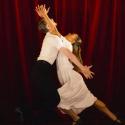
Scènes de Ballet is a formidable undertaking. The ballet as a whole is like a chillingly beautiful woman: entirely, self-sufficiently aware of her beauty, she doesn't trouble to charm or entice. We can take her or leave her, and either way, she is remotely, coolly indifferent, like the moon.
On a more practical level, Ashton made the piece as an examination of angles: the corps, the soloists, all “read” as pieces of geometry. Further, each dancer is expected to epitomise angles individually, by using épaulement, the placement of head and shoulders, to clarify and extend the dimension and position in which the dancer stands in relation to the audience.
That’s the theory. In practice this afternoon, some of the dancers understood and shaped their performances – Sergei Polunin, producing yet another elegantly defined role – and others didn’t.
Lauren Cuthbertson, in the lead, has added numerous roles to her repertoire in the last year. In some she has been formidable – she was a ferocious, driving, urgent force in Balanchine’s Serenade, and a sweetly pretty Alice in Christopher Wheeldon’s Alice in Wonderland. But in others she has appeared rushed and flustered, whereupon her style reverts to that of a competent soloist.
The steps were there, but the detail was smudged. One passage is a series of bourées, a small lift in passé, and, simultaneously, the hands flick over from palms up to palms down. Nothing complex, but her hand shift had no weight, was almost invisible – and it is that flick that counterpoints Stravinsky’s chic little rhythm and drives home what Ashton is doing.
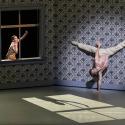
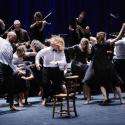
 Voluntaries was created by Glen Tetley for the Stuttgart Ballet in 1973, immediately after the death of its director, John Cranko, and it inevitably carries an elegiac air, not only for Cranko, but for the memorable partnership of Marcia Haydée and Richard Cragun. The pairing of Leanne Benjamin with newcomer Nehemiah Kish, who appears to be at least 30cm taller than his minute partner, is perhaps not destined to be as memorable. Benjamin, a focused, dramatic performer, seemed uncomfortable; Kish, with his great height and large body, is perhaps not suited for Tetley’s sleek, fleet choreography.
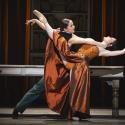
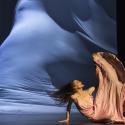
By contrast the trio, often a high point of this piece, featured the steel-sprung joints of Sarah Lamb (pictured right, © Bill Cooper), as well as the delightfully buoyant and well-paired Ryoichi Hirano and Valeri Hristov (standing in immaculately for an indisposed Thiago Soares), both of whom seemed to revel in Tetley's slippery river of steps.
And best of all was the splendid organ-playing of Thomas Trotter: kudos to the Royal Ballet for this invitation to an outstanding musician.
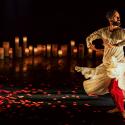
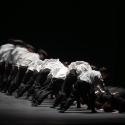
That was the good news. The bad news is Macmillan’s Rite of Spring. Macmillan created the piece in 1962, using Sidney Nolan’s aboriginal-inspired sets and costumes, and developing a generic, simplified “primitive” vocabulary. On an aesthetic level the piece is a nursery version of Nijinska’s Les noces, without either her rhythmic sophistication or her ability to encompass pity and terror. On a sociological - or human - level, what might have been acceptable, even unnoticeable, in 1962, is not so in 2011: the piece, at best, describes an aboriginal people and culture in unpleasantly reductionist, stereotypical terms. It is past time to put it to rest.
 Find recordings of