It is claimed that the philosopher GE Moore had a fantasy. After many years’ work, Tolstoy had finally finished War and Peace. Sonya had copied it out for the umpteenth time. The thing goes off to the printer. Peace reigns. And then, in the middle of the night, Tolstoy leaps out of bed, shrieking, “I forgot to put in a yacht race!”
Well, that was War and Peace. Alexei Ratmansky hasn’t tried to distil that monster into ballet, but has instead gone for the (relatively) brief Anna Karenina. But by God, he’s got the yacht race in all the same – or, at least, a horse race.
Indeed, the horse race was my favourite part of the evening. Ratmansky has tied himself to composer Rodion Shchedrin’s 1972 Anna Karenina score, created for his wife, Maya Plisetskaya, and the score sounds pretty much like the way the Bolshoi were dancing in the 1970s – a score for a silent movie, the urgent accompaniment to waving capes, rolling eyes, everyone making sure at every moment that every emotion is carried to the farthest balcony. While Ratmansky’s taste is far too refined and elegant for that, the music is a constraint, constantly driving him forward even as one senses he really would like to linger, to explore, to explain.
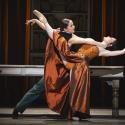
 Instead, scenes, mostly pas de deux, zip past at breakneck pace. Anna (Diana Vishneva) is dead in a prologue; then Anna meets Vronsky (Yuri Smekalov, pictured right, with Uliana Lopatkina, photo by N Razina); Vronsky falls in love; Anna is torn; zip zip zip, before you know it, the first act, a remarkably brisk 40 minutes, is over and we’re back in the hallway. Although the act has presented us with two balls at which theoretically social interaction takes place, in fact all the subsidiary characters in the novel (carefully listed out in the programme by name, so ostensibly important) are entirely interchangeable. Is that Kitty? Is it her sister? Her mother? Oh hell, no, it’s Anna.
Thus, when Act II opens on a scene that lasts more than a few minutes, one can feel not only Ratmansky, not only the dancers, but the entire audience relaxing into it. Anna has accompanied her husband (Islom Baimuradov) and much of Petersburg society to the races. Vronsky is riding, he falls and Anna’s anxiety for her lover causes her to reveal her true feelings. This could be another of those little pocket-rocket scenes, but it is as if Ratmansky has given himself permission to enjoy a theatrical moment for the first time in the evening, and also to charm us with the type of originality we have grown to expect from him.
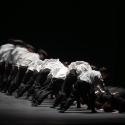
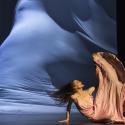
The set throughout is a flattened ellipse, with splendid video projections (by Wendall Harrington) shown in quick succession: storm clouds, or Petersburg scenery, or Karenin’s grand library, or Vronsky’s much humbler apartments. At the race track, we move between thundering horses’ hooves above, and a corps of men, who had previously represented Vronsky’s regimental friends, now half-horses, half-riders, while Shchedrin’s music is at its most compelling here. It is a conceit brilliantly achieved, and reminds us with a little jolt of pleasure of Ratmansky’s years in Denmark – a witty homage to Bournonville’s Jockey Dance.
There are some fine performances. Vishneva’s air of tragic grandeur fits well into this role, although, while as a dancer she has the magnetic allure Tolstoy gave Anna, dramatically one senses there is still more to come. Smekalov’s Vronsky dances strongly, with a lovely clean line. But it is Baimuradov as the betrayed Karenin who manages to achieve most dramatically, creating out of very little Tolstoy’s dry but bereft man, a man of pathetic, heroic restraint.