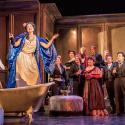
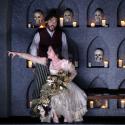
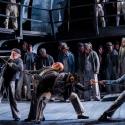
This very human comedy - for once the clichéd phrase "unjustly neglected masterpiece" may not be so far from the truth - needs lustrous warmth from a team of Russian singers, glittering dance, luxurious fantasy in its presentation and crispness in the staging. At the Royal Opera, it gets all but the last. The house's Director of Opera Elaine Padmore was convinced that of all the operatic Cinderellas she nurtured at the Wexford Festival, The Tsarina's Slippers was the one which deserved to go to the Covent Garden ball. So she brought in effective show-stager Francesca Zambello to work with designers conscious of their national magic-realist heritage, Mikhail Mokrov for the sets and Tatiana Noginova for the costumes.
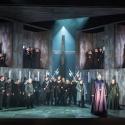
Mokrov's dropcloth, a zigzagging collage of St Petersburg facades and the Ukrainian village where Vakula the blacksmith has painted the Devil on the church wall, keeps us visually occupied during the overture. In the first of many short cuts, it's shorn of its development, and briskly conducted by Alexander Polianichko. How curious that, having poured money into most aspects of the show, they didn't engage a more glamorous animator like Rozhdestvensky, Gergiev or Jurowski. Keeping the action on the move, Polianichko finds plenty of rubies and emeralds embedded in the score, but fails to reveal Tchaikovsky's consistent diamond-like invention.
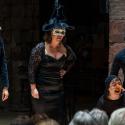
That's partly why the audience seemed slow to warm to the opening scene. Zambello doesn't give her singers enough help, either. Larissa Diadkova has long been an international treasure of a true Russian contralto, ripe now for witchy parts. Yet her stock Solokha, all smiles and casual sashays of the kind Russian singers habitually employ to depict babushka characters, was sketchy compared to her shoulder-shrugging, casual malevolence as Jezibaba in the Glyndebourne Rusalka, under the more imaginative eye of director Melly Still. Diadkova's Devil, Maxim Mikhailov, was vocally no match for her. He seemed to be marking the role at a final rehearsal, barely audible in the upper register. He and his infernal henchmen needed more to do than simply waggle their tails and behinds.
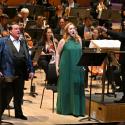
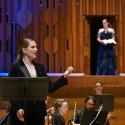
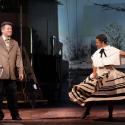
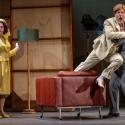
 Tchaikovsky was luckier in the chemistry between tenor and soprano here (Vsevelod Grivnov and Olga Guryakova pictured right). Olga Guryakova's Oxana, helpfully framed in Mokrov's detailed, downstage cottage interior, sensitively suggested an insecurity and inexperience in love with which the composer presumably identified and reined in a big, luminous Slavic voice with varying results for the top notes. Tchaikovsky's most heartfelt heroine, Tatyana, is only just around the corner; Guryakova knows this and other ingenues well, and brought the same naturalism to bear. Vsevolod Grivnov as her perplexed wooer is a singular lyric tenor rather than the heroic specimen the role really requires, and his big Act One aria needed to blossom, but his engaging tone and his identification with Vakula's charming naivety worked wonders. Regrettably, we don't get to hear the Christmas carolling backdrop to the confused lovers' spat - another cut - but the later, tuneful set pieces of their public confrontation certainly come alive.
Most of the cameo roles are taken by experienced Russian troupers, able to fend for themselves given limited direction. Vladimir Matorin, a rock-solid bass unlike Mikhailov, effortlessly dominates the stage as Oxana's father. In the tricky scene where Solokha hides her portly would-be village Romeos in sacks, the superb Viacheslav Voynarovskiy makes exuberant work of the couplets which usually make the action drag - among the many additions Tchaikovsky made to the score in his revision.
Another, the imperial boot- or slipper-licking verses declaimed in rococo style by Catherine the Great's right-hand man "His Highness", taken here as a portrait of Prince Potemkin, showcases the charisma of Sergey Leiferkus. One verse rather than two would have put his now veteran baritone under less stress, and it seemed a strange decision to further hold up the action before Vakula gets the Tsarina's slippers his sweetheart desires. Why, on the other hand, cut the curious Gogolian scene where he meets a group of Zaporozhy cossacks in the palace antechamber? It helps to build anticipation for the splendid imperial Polonaise, abruptly introduced, and explains the ensuing competition between Russian and Ukrainian dances. The longest and most splendid of many Gopaks in the score provides the vigorous highlight of the evening, brilliantly executed by four high-kicking masters of the art.
 Alastair Marriott's choreography for Royal Ballet dancers is rather more conventional, appropriately enough in the St. Petersburg scene. But why the men in the weedy number for rusalkas or ondines by the lake where Vakula has earlier thought of drowning himself? Surely the drowned maidens need the pool to themselves: another case in point where comparison with Melly Still's strange and dangerous motivation for her nature-spirits at Glyndebourne showed up the old-fashioned style of this production. We haven't moved on from the quaint imperial fantasies designed by the likes of Bilibin, Golovin and Korovin and recently resuscitated at the Mariinsky - nor, many would argue, should we. But surely there's room to fill the gorgeous sets with more original gags and dances.
Should you come away feeling seasonal warmth, better for the experience? Ultimately, I did. Tchaikovsky's fast-moving happy end and striking final chorus do much of the work. The rest is achieved by Noginova's rainbow costumes, Mokrov's final blaze of sunlight and a show-style curtain call reprising the big tune. Zambello and Polianichko are forgiven for earlier plunges in the energy levels, but I love this work, and I still feel they haven't pulled it into sharp enough focus. There's room for more life and detail to emerge as the run proceeds.
- The Tsarina's Slippers has performances at The Royal Opera House until 8 December. Book online here.
- See a gallery of Tatiana Loginova's costumes and Mikhail Mokrov's scene designs in theartsdesk here.
- Francesca Zambello and other creative directors talk to the artsdesk about the production
See theartsdesk's exclusive and comprehensive gallery of production photographs and designs here.
Check out what's on in the Royal Opera House season