Lehár’s Merry Widow has been been spreading enchantment across the globe for well over a century. She’s the vintage champagne of operettas, and the prospect of John Wilson popping her cork was more than a little enticing. Wilson, one feels, instinctively knows how this music goes and indeed did so before even the composer put the notes on the page. He was surely born into the wrong century. So why do I feel a "but" coming on? Why did this particular magnum of bubbly not go to my head?
First the positives. Presenting the Widow in concert has to be about the numbers; the dialogue - a problem at the best of times - just doesn’t hack it outside of the theatre. Tom Stoppard was the first, I think, to write an English narration for the piece and his idea rather wittily supposed that the minor character of Njegus, Confidential Secretary to the Embassy of Pontevedro, was the man in the know and (as with Rosencrantz and Guildenstern) put him at the centre of the proceedings. Simon Butteriss has replicated that idea for John Wilson and the Philharmonia Orchestra, and indeed has done so with more wit and a great deal more charm than even Stoppard did.
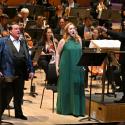
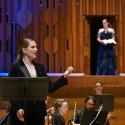
 Butteriss is a Gilbert and Sullivan stalwart whose dapper delivery hits just the right note of satire. The mythical state of Pontevedro is close to bankruptcy as the curtain rises at its embassy in Paris, so you can just imagine the irresistible temptation for jokes on European insolvency. Butteriss lands them all. But my favourite of his interventions was his dubbing of embassy wives as "diplomatic bags". Plenty of mileage in that one (John Wilson at work, pictured above).
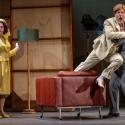
The other cleverness about the narration is that Butteriss has designed it to be played as part of the action so that he is often standing invisibly in the midst of quite intimate situations. It proved to be an ingenious device from the man who also directed this semi-staging, and when Butteriss did finally get a number of his own it came with a lyric from Jeremy Sams that was naughty enough to pass off as the performer’s own. No prizes for guessing where the strategic pause came in “a mouthful of coq au vin”.
So it was very much Butteriss's show - and that, in itself, suggests that all was not well. One of the biggest problems was the balancing of voices with Wilson’s lavishly full-sized band.
Lehár’s masterpiece was a huge advance in this repertoire with a textural and harmonic sophistication previously unheard in the genre, and as Wilson pitched into the opening pages with an explosive zest that suggested he had shaken the bottle before popping the cork, we knew we were in good hands. Pacing and phrasing were spot on as waltz succeeded waltz and galop swept aside gavotte.
Not even Wilson could save the evening from a lingering feeling of unfinished businessBut the band was way too much for the voices in act one, and all but Butteriss and the excellent Alan Opie as Baron Zeta (who one wished had had more to sing) were fighting for audibility. In act two the voices (or some of them) were suddenly and conspicuously amplified, raising the question as to whether complaints had been made in the interval. I couldn’t identify how the enhancement was achieved (there were no obvious radio microphones) but levels came and went and felt arbitrary. Why was this not sorted in rehearsal?
But that raises another question concerning casting. At the heart of Widow is the lady herself and her long-infatuated Count Danilo. While Claudia Boyle and Daniel Prohaska both vocally and physically had the freshness of youth on their side, what neither exhibited was that indefinable charisma that so dramatically raises the stakes as to whether or not they will finally say how they feel about each other. Boyle had all the notes, and very lovely they were, but she didn’t begin to transport us with the big hit number “Vilja” - her thinly disguised confession of love - any more than Prohaska did with his melancholic counterpart.
The aching nostalgia of Lehár’s disarming waltz for Hanna and Danilo, of course, says more than words ever could about their love, but not even John Wilson’s self-evident affection for this piece could save the evening from a lingering feeling of unfinished business.