The worldwide success of John Cranko’s 1960s version of Tchaikovsky’s opera, in turn an adaptation of Pushkin’s verse-drama, might have taken even the choreographer by surprise. Tchaikovsky himself worried that “Pushkin’s exquisite texture will be vulgarized if it is transferred to the stage”, and added, “How delighted I am to be rid of Ethiopian princesses, Pharaohs, poisonings, all the conventional stuff.”
No scenic effects? No excess? No melodrama? Well no, not quite. First, Cranko was not permitted by his opera house to use Tchaikovsky's opera, so instead had Kurt-Heinz Stolze reorchestrate various scraps of pieces from other Tchaikovsky works: not a satisfying aesthetic whole. Then, while Cranko didn’t put in Ethiopian princesses, or Pharaohs, or even poisonings, he did add yards of melodrama instead of Pushkin’s “exquisite textures”, carrying on from where he left off after his Romeo and Juliet three years before. In his retelling, Onegin is primarily the story of a girl’s coup de foudre. Unlike Romeo, however, the man she falls for is a cad and a bounder. He rejects her coarsely, with contempt handing back the letter in which she has declared her love, before he betrays and then kills Lensky, his best friend and the affianced of Tatiana’s sister Olga, and spends years (offstage) repenting, only to be rejected in turn by Tatiana, who loves him still but has found contentment with Prince Gremin.
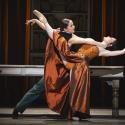
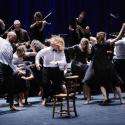
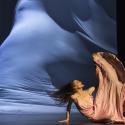
 In Cranko’s Onegin we are not in Russia, but in Conventional-Melodrama-Land. Thus, it is the individual dancers that make or break the evening. On the first night, the Royal fielded a formidable cast, with Alina Cojocaru as Tatiana, Steven McRae as Lensky (pictured right), Akane Takada as Olga and Bennet Gartside as Gremin. Johan Kobborg, injured, was replaced as Onegin by Jason Reilly of the Stuttgart Ballet, and it is perhaps suitable that the “outsider” of the story was an outsider, too, to company style.
Reilly’s Onegin was not Pushkin and Tchaikovsky’s burdened, tortured man, but a cynical slicker from the city, sneering at the hicks. His dancing was accomplished, but two-dimensional.
The sisters, Tatiana and Olga, worked harmoniously to divide up the evening. The rising Akane Takada was charmingly light and bright as the happy, girlish Olga. Takada has been taking on increasing roles, and as Olga she continues to deepen both technically and in dramatic presence.
Steven McRae, as Lensky, matched her in charm, and his solo before the duel and his death, often the emotional core of the story, was finely achieved.
 Cojocaru in the early scenes was recessive as the dreamy Tatiana. It was with her entry with Olga, as they attempt to prevent the duel, that her emotional force could begin to dominate the evening, and from there on her laser-like focus never wavered. The later scenes, with her husband, can be some of the most touching in dance, and Gartside’s tender care and admiration for his wife built up a picture of that great theatrical rarity, contented love.
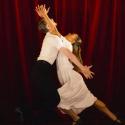
Onegin’s return, and the parallel structure of the letter – in the last act he writes Tatiana, and she rejects him – was beautifully achieved. It’s just that Reilly’s Onegin (pictured above left) was so unlikeable, you had to wonder a little at Tatiana’s despair.