It’s hard to put one’s finger on why George Benjamin’s new opera doesn’t work. It comes to Covent Garden with a wind in its sails. Its outings in Europe have all received high praise. It boasts a classy cast, Martin Crimp as librettist and Benjamin at the helm of the orchestra. The story is a captivatingly horrific medieval morality tale that often goes by the title of "the Eaten Heart story". And there’s little wrong with Katie Mitchell’s production.
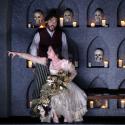
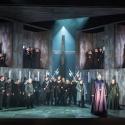
On one level Written on Skin explores a simple ménage a trois, in which a loveless couple allow a stranger – an illuminator of manuscripts – into their lives and have their lives turned upside down by him. On another it’s about the dangers of inviting an artist to hold up a mirror to your circumstances. Will you like what you see? There are echoes of things like Theorem by Pasolini and Pelléas et Mélisande by Debussy, and, in Jon Clark's lighting, Tarkovsky and Caravaggio.
All three principal voices offer a beauty of tone that beguiles throughout
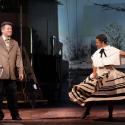
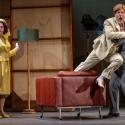
It is sophisticated in the way that it allows one’s sympathies shift. Christopher Purves is anyway too clever an actor to let the oppressive husband Protector to remain a basic villain and one quickly starts to empathise with him – in spite of his vileness – as one witnesses his wife, Agnes (Barbara Hannigan), lusting after the artist stranger (Bejun Mehta) and finally succumbing to him.
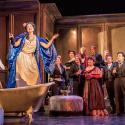
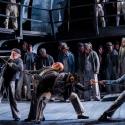
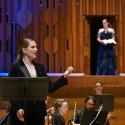
Vicki Mortimer's sets complicate things in a good way. One half of the modernist doll’s house we look into - the half housing the couple – is quasi-medieval, the other – where intervening angels and their helpers work - 21st-century. Interesting questions arise from this juxtaposition, as it appears that fantasy is housed in the modern world and reality in the medieval.
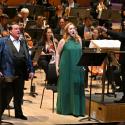
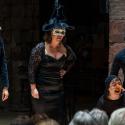
And one can't fault the singing. All three principal voices offer a beauty of tone that beguiles. Purves and Hannigan, especially, use their timbral beauty to elucidate character in a masterclass of nuance and understanding. And both bring a bodily flexibility to this vocal plasticity that means that it is hard – even when other elements are conspiring against us – to gainsay what's going on on stage.
All that was needed to give life to this is a decent score. And while we got a clever score, one that attended to all the superficial needs of the libretto – sultry music here, loud and dramatic music there, pseudo-medieval touches there, all alluringly teased out by Benjamin on the Royal Opera House podium – we were short-changed on melody and emotion. You only have to read the interview with Benjamin in the programme notes to see why.
Fear pervaded this first attempt at a full-scale opera from Benjamin. Fear of realism. Fear of the audience. Fear of quotation. Fear of modern opera's ability to sustain interest.
The result is music that feels hemmed in, that tiptoes around (almost literally in the extended pizzicatoing). It's careful, neat, safe, po-faced music (he's always stumped by Crimp's humour) that dutifully hangs on every word, confirming its dramatic or psychological meaning, but rarely if ever adding anything more to it. It’s a score low on inspiration and high on pedantry.
There are scenes that work well. The slow-motion chase - husband after wife - in the last few minutes, the spectral sound of a glass harmonica wafting up from the pit, makes for a terrific finale. But this is music that goes only skin-deep.