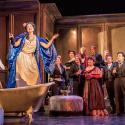
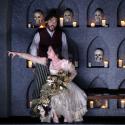
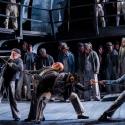
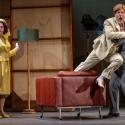
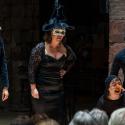
In Britten’s centenary the Aldeburgh Festival has come up with two mesmerising opera happenings. The innovation is to stage Peter Grimes on the town’s beach, a few hundred yards from the composer’s beachside Aldeburgh first home, amid a splurge of decaying fishing boats. The daring recreation is to present all three of his orchestrally bewitching 1960s Church Parables in their original setting, Orford Church, where Peter Pears famously created three roles: the distraught Madwoman in Curlew River, haughty Nebuchadnezzar in The Burning Fiery Furnace and The Tempter in The Prodigal Son.
As an inspired decision, Aldeburgh drafted in The Opera Company’s Frederic Wake-Walker to direct all three with the equally ground-breaking company he founded, Mahogany Opera.
My money, vocally and dramatically, was on baritone Samuel Evans, who nary put a foot wrong
To say that Wake-Walker has the brightest, boldest mind among Britain’s younger directors is an understatement. His knack of energising top-drawer lead singers (Glyndebourne, Buxton, Opera North), those of student age (an astonishing realisation of Stravinsky’s Renard in London’s East End), and schoolchildren alike (Wake-Walker’s staging of Hans Krása’s Brundibár - the Nazi-era Terezín ghetto opera - in Aldeburgh’s Jubilee Hall closely rivalled the original) marks him out as one of the most original and disciplined directors of our day.
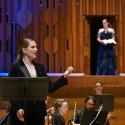
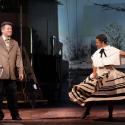
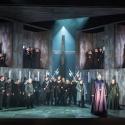
Here was a cast - led by the visually, as well as vocally, gifted tenor James Gilchrist - of young men (monks headed by a superlative bass Abbot, Lukas Jakobski), and boys, cowled novices who yield a brilliant floorshow, wiggling hands, legs and pelvises teasing out shockingly sensual shapes and gyrations. Kitty Callister’s furnace design (a layered series of stained glass shards) made a dazzling, breathtakingly apt climax. Ben Payne lights often from below, alternating eerily sinister and beauteous effects.
The eight-man chorus not only mastered Britten’s unusually complex vocal lines and harmony, but every single stylised hand or body gesture had the intensity of a saintly medieval woodcut. Witness their aching sympathy for the old-young crone in Curlew River, culminating in the miraculous appearance, shadowed behind a raised sail (then revealed like a dove), of the white-clad boy’s soul (treble William Rose is at 13 already a proven high-class Aldeburgh performer). Witness the gross carousings in The Prodigal Son, or their sinuous mocking, topped by violent red attire, in The Burning Fiery Furnace, where another gifted boy treble, Lucas Evans, supplied the benedictory Angel.
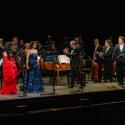
The most violent reds picked out Gilchrist’s creepy Nebuchadnezzar, oozing temporal excess, counterpointed by Jakobski’s glutinous Magus/Astrologer and Gilchrist’s Machiavellian plottings. Tenor John McMunn’s vulnerable Younger Son uplifted The Prodigal Son. Less gripping than the others but still riveting were the Aurora Orchestra’s young soloists (percussion, timps, low strings, orientalised flutes, horn above all) overseen by Roger Vignoles.
Rodney Earl Clarke excelled as the Prodigal’s potentially murderous elder brother. Yet my money, vocally and dramatically, was on baritone Samuel Evans, singing the fascinating role of the Traveller in Curlew River. He put nary a foot wrong. Useful when wading in deep.