Whatever it was about the kings and queens of England that so intrigued Donizetti, it certainly wasn’t their politics. The third, and last, in WNO’s autumn cycle shows Elizabeth once again in a state of unrequited love with one of her rebellious (and much younger) nobility, but wholly unconcerned with affairs of state; and the one thing that distinguishes her from the average abandoned woman of Romantic opera is that she has the power to decapitate her uncooperative swains. Freud would have nodded sagely; but it’s unlikely that Donizetti was thinking of emasculation.
Though neglected, Roberto Devereux is by no means a pure Wexford-style no-hoper. Uneven it may be, and prone to fall back, like so much bel canto opera, on a repertoire of more or less mechanical rhythmic and harmonic devices. But it also has two or three scenes as powerful as anything in Donizetti’s better known work. The title character is the selfsame Earl of Essex of Gloriana fame, home from the Irish campaign against Tyrone and eager to resume his adulterous affair with the young Duchess of Nottingham. Unfortunately the queen is also in love with him, turns against him when she realizes he is otherwise engaged, agonizes over whether or not to countermand Parliament’s death sentence for treason, then eventually does so but too late.
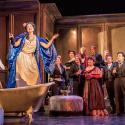
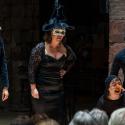
 Some of these situations ring bells from Maria Stuarda. But the balance is musically very different. We again get two sopranos, but there is no confrontation. Elizabeth rules the upper registers, while Sara, the duchess, weeps at home. Donizetti uses the queen’s coloratura cleverly to depict her unstable emotional condition, torn between command and helpless passion as she tries desperately, an aging, over-powdered woman, to extract some response from Devereux beyond superficial loyalty. Alexandra Deshorties (pictured right with Capalbo) – hideously made up with dyed red hair piled up above gaunt features and withered bosom – is brilliantly convincing in all this; and Leonardo Capalbo’s reaction – embarrassed, trapped, evasive – is likewise precise, though his dignity isn’t greatly helped by director Alessandro Talevi kitting him out in cheap leathers, like some Milanese taxi-driver.
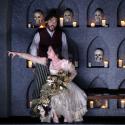
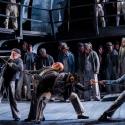
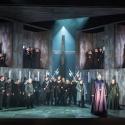
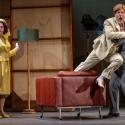
Later, there are superb scenes for Nottingham himself, the cuckolded but unsuspecting husband, with Devereux, and (no longer unsuspecting) with his poor, defenceless wife – music in which Donizetti achieves a near-Verdian intensity; and on the other hand a dramatically important scene with Elizabeth that relapses into pure Italian rum-te-tum. At such moments, the composer seems to have handed his work to a typewriter. But they are mostly outweighed. And though I don’t much care for Talevi’s settings or Madeleine Boyd’s designs – the same kinds of monochrome airport lounge as in the two previous operas enlivened by back-silhouettes and bizarre props including an enormous spider-machine on which Elizabeth rides against Devereux – the actual stage direction is very powerful and makes the most of Donizetti’s genius for vocal fisticuffs.
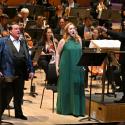
A strong cast helps make this work. Deshorties is a soprano of real character and athleticism, and a striking figure on the stage, towering over Capalbo, himself no mean bravura tenor, if not exactly such as to have made the Irish shake in their shoes. The best of several males who, with one motive or another, circle round the queen is David Kempster in the baritone role of Nottingham, the wronged husband (though we know Sara to have been forced into marriage), initially warm in his affection for Devereux, violently recriminatory of his wife, Leah-Marian Jones, a much lighter, sweeter soprano than Deshorbies, but equally stylish in her way. Geraint Dodd is also excellent in the latest incarnation of the by now elderly (and in historical fact actually dead) William Cecil. But what did history matter to Donizetti? It was situations he adored.
Daniele Rustioni returns to conduct, and again, as in Anna Bolena, has one admiring the composer’s orchestral ear when one wearies of the um-chahs. Orchestra and chorus take as much care as if this were Rigoletto or Aida, as they have done throughout the cycle: and it's not wholly unmerited.