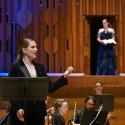
For a brand-new opera group to set something as ambitious as Don Giovanni before an audience demands sackfuls of self-awareness and confidence. But the eight young singers of Opera Vera are no mere enthusiasts – they are rich in experience and can all boast busy CVs – so it would be discourteous to consider them by anything other than rigorous professional criteria. Given the opera’s countless bear-traps, then, it is not to damn with faint praise to say that they produced an intelligent and thoroughly musical account of Mozart’s score.
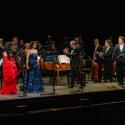
Accompanied by 11 musicians from the Brillig Ensemble (an alumni offshoot of the Southbank Sinfonia) under Philip Hesketh, the orchestral aspect was perfectly competent, albeit hamstrung by the lack of numbers. There were patches of exposed playing because the orchestra was simply too small to do justice to the score’s many colours; reduced forces may work for the early piano concertos but Don Giovanni is mature Mozart and demands a richer palette. As it was, not only was there tinkering to cover missing instruments but the mandolin accompaniment to "Deh vienni alla finestra" was played on an accordion and the continuo on a modern grand piano. The chorus part was entirely excised. It was that sort of evening: pleasant on the ear but not exactly historically informed.
The opera’s dramatic discords felt more like a Synod schism than a night in bunga-bungaland
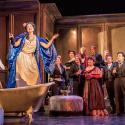
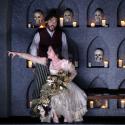
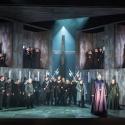
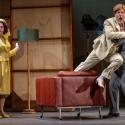
The production, such as it was, need not detain us long. Opera Vera’s pre-publicity claimed to place the work in Silvio Berlusconi’s Italy but little of that impinged on the performance beyond a few perfunctory slogans and some stickers given to the audience on arrival. Director Nina Brazier made such free use of existing church paraphernalia at St Paul’s, Covent Garden – pulpit, pews and chair – that the opera’s dramatic discords felt more like a Synod schism than a night in bunga-bungaland. No matter; with Don Giovanni’s notorious failure rate it’s better to be on the chancel steps than in the director’s graveyard.
It was refreshing to hear good young voices in an opera that deals so candidly with human urges and emotions. James McOran-Campbell as the wicked Don was magnetic: a man possessed by a sexual energy that left him unable to function at normal levels of human interaction. His command of the role was assured and his vocal quality, wanting only a true sotto voce, terrifically exciting. He is only a few vocal colours away from being a considerable Don Giovanni.
McOran-Campbell was well partnered by Peter Brooke as his Sancho Panza-in-sleaze, Leporello. After a hesitant start (not helped by an unfortunate lighting glitch) the youthful baritone traded swagger for stupidity but kept the gurning this side of idiotic. His warm baritone was a revelation and he delighted the audience with his catalogue aria. Alexander Anderson-Hall as Don Ottavio seemed less comfortable by comparison: he acquitted himself well in the opera’s sublime tenor arias (both of which were retained) but tended to disappear in duos and ensembles.
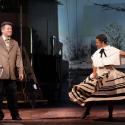
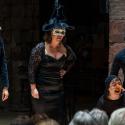
The distaff battle was a hard-fought contest, with Susan Jiwey an impassioned Donna Elvira (albeit with a few issues of precision in recitatives), Stefanie Kemball-Read a fervent Donna Anna (despite some stridency under pressure) and Rebecca Dale the winner on points as a manipulative Zerlina who sang with great character while wearing a skimpy white dress that had a mind of its own. Her other half, Masetto, was finely characterised by the excellent Nicolas Dwyer, while the steady Will Kwiatkowski, though more a light baritone than a bass, carried both dignity and menace as the Commendatore.
The Actors’ Church acoustic was not kind to the contrapuntal ensemble writing that is such a dominant element in this opera, and it must be said that few of the evening’s performances were strong on subtlety. Despite the sub-minimalist staging there were moments of careless stage management and some bad surtitling errors that affected both "Il mio tesoro" and "Mi tradi". Yet for all its rough edges this was a compelling evening whose three hours flew by at a lick, and an assured début from a company that deserves to thrive and grow.