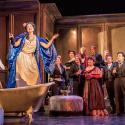
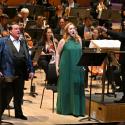
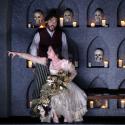
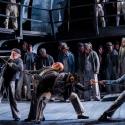
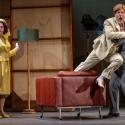
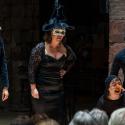
Usually, anyone bringing tuberculosis and transgression to the regional centres of Woking, Norwich and Milton Keynes would meet redoubtable opposition. In the case of Glyndebourne’s new touring production of La traviata, that would be a shame, because this is a lean, powerful version that reaches straight for the heart and gives it a good squeeze. In Russian soprano Irina Dubrovskaya and American tenor Zach Borichevsky, Glyndebourne has found very convincing replacements for the acclaimed Festival performers Venera Gimadieva and Michael Fabiano, who enact director Tom Cairns’ vision of psychological realism with great conviction.
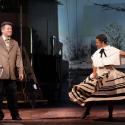
This version places the psychology of the central couple’s relationship at its heart. From the first, the stage acting is closely observed, with effective gestures throughout, such as Violetta’s refilling of Alfredo’s champagne glass just before his toast to love. Alfredo’s no chest-beating macho, but a nervous and slightly gauche young man on the brink of self-discovery, and the gangling Borichevsky captures his faltering journey well. That vulnerability seems to be the attraction for Violetta, who, finally looking for love rather than an employer for her courtesanship, has tired of the likes of Baron Douphol.
In a rather brilliant re-focusing of Violetta’s character, director Tom Cairns seems to see her tragedy as psychological. There was, tellingly, very little of the consumptive coughing traditional in the role: from Act One, where she’s unsure of his love, to Act Two, when she is easily deterred by Alfredo’s father, Giorgio Germont, and wonders aloud whether, as a courtesan, she can deserve or achieve real love, it’s a crisis of confidence as much as anything. When, at the end of Act Two, Violetta tells Alfredo he can’t understand her love, the accusing eyes of the party upon her, she seems more likely to be high, drunk, or depressed than dying of tuberculosis. Being trapped in the skin of a courtesan seems to be what kills her.
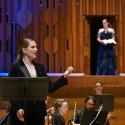
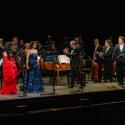
Both leads needed 15 minutes to warm to their roles, until which there was a brittle, metallic edge to their voices. They shared a light, lyrical quickness, well adapted for the many scenes of dialogue. Neither (yet) has the power to fill the hall, or send 240 volts down the spine, but they were appropriately matched to characters defined by anxiety and struggle, and by the end, Dubrovskaya in particular was sounding very fine. The Glyndebourne Touring Orchestra under David Afkham accompanied sensitively. What their sound occasionally lacked in lustre it made up for in the sprung vigour of the bustling party scenes, where tension is powerfully evoked by the contrast between the fine lines of the upper, and gutsy pulse of the lower strings.
 Alfredo’s father, Giorgio Germont, is a more complex figure than the pompous, paternal buffoon of operatic stereotype. Quick to realise Violetta’s sensitivity and to regret his own interference, his rather woolly depiction here, by Roman Burdenko (pictured right with Zach Borichevsky), had more stuffing than shirt about it, a feature unfortunately symbolised by the failure of the glue on his false moustache. It was hard to believe that even a demoralised Violetta would find this figure, trailing strands of moustache from his pallid chops, at all imposing.
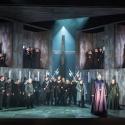
The period-lite set was for me the production’s weakest feature, though you can see what they’re getting at. Act One’s two huge curved screens, one red and one blue, aspire to suggest the drama’s public-private, Alfredo-Violetta dichotomies, though they have an unhelpful, Travelodge blandness, and the red-blue colour scheme does tend to make one fear that at any moment Dave and Ed will burst onto the stage, bandying tax cuts. Act Two was, if anything, worse, with only a backdrop – a kind of blurry, Monet-shopping-bag floral wash – to suggest the rustic intimacy of the couple’s retreat. Act Three worked best, the poignantly diminutive chandelier over Violetta’s bed suggestive of her fall from splendour. Costumes are, for the most part, non-committal rather than hugely evocative, though Violetta’s combination of elegant silvery dress – a silver that changes so easily to a leaden corpse’s pallor -– and scarlet courtesan’s gown seemed cleverly symbolic of her split identity.
Each act began with Violetta lying on her bed, lit in a silvery, spectral moon-wash. It’s an evocative touch, which mirrors the yearning string theme repeated from the overture onwards. By the moment of Violetta’s final collapse, there’s almost, dare one say it, a touch of liebestod about the way she's only free to love in death.
This is a refreshing production, which dispenses with fusty moralising and tired critiques of a bourgeois morality that is difficult to make real for today’s audiences. As the curtain comes down on Violetta’s corpse, still lit in ghostly white, but now centre stage, we understand Violetta’s ultimately fatal struggle to have been that which we find at the heart of most great drama, to be yourself.
- Glyndebourne Tour's La traviata is perfomed at Glyndebourne on October 7, 11, 17, 22 and 25, before going on nationwide tour.