After Calixto Bieito’s radical reimaging of Carmen, which opened at English National Opera this week, David McVicar’s version at Glyndebourne was bound to seem conservative. But it turned out to be a comparison of apples and Seville oranges: Bieito is certainly bolder, but McVicar is more sophisticated and digs deeper into the raw emotions of the work. It’s not a new production, but revival director Marie Lambert has kept it fresh, aided by a stunning cast and dynamic, energised conducting from Jakub Hrůša.
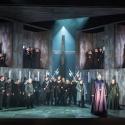
McVicar sets his Carmen in the mid-to-late 19th century, a gentle updating that is most evident in the Act I set. The tobacco factory is presented as a mechanised and industrial affair, but in a state of decay. A large broken cog sits at one side of the stage and the colour scheme is rust-red. All very steam punk. In the second act, Pastia’s inn is in a small basement, entered from the street, visible above. The sets for the first two acts are large, but they force the action into the very front of the stage. That requires some imaginative positioning of the chorus, dancers, actors and children, who always seem to be competing for space, but it also serves to focus and concentrate the action. The stage opens out in the third act, the smuggler’s hideout a bare stage with just a wagon of booty in the centre and much dry ice for fog. And the finale takes place in front of a towering bullring wall, its ochre hue a visual reference to the rust red of Act I.
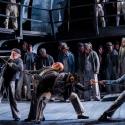
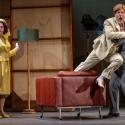
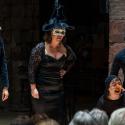
 Characters are finely drawn and carefully observed. Particularly impressive is Don José, sung by the Czech tenor Pavel Cernoch. His transformation and decline animates the production, from his first appearance as a shy and disinterested career soldier in Act I to the very credible murderer at the end (pictured right, the final confrontation). The final stages of his descent are perfectly realised at the end of Act III, as he stabs wildly with his knife into the engulfing fog, the offstage Toreador’s Song a phantom haunting his thoughts. Cernoch has a soft voice for the part, but it is agile, lyrical, and always secure.
But the evening belonged to Stéphanie d’Oustrac, who was born to play Carmen. She is captivating from start to finish, completely dominating the stage whenever she appears. Again, not a huge voice (she’s better known as a Baroque specialist) but big enough to fill this house. She is always seductive and always gives the impression she’s playing by her own rules. Just listen to the way she pushes and pulls against Hrůša’s beat, teasing him as much as she does Don José, Zuniga and the rest.
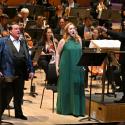
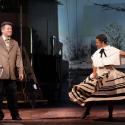
 A strong supporting cast with no really weak links. David Soar (pictured left) has a rich tone as Escamillo, although is uncomfortable on some of the low notes. Lucy Crowe sounded a little husky as Micaëla – a slight cold perhaps? – but this never threatened the evenness of her production or the empathy she evoked for the character. (Why bring her back onstage for the dénouement though? That seemed crass.) Simon Lim appears on the cast list but not in the programme as Zuniga, suggesting a late substitution. But he gives far more that an understudy performance, bringing a commanding but agile bass voice to the role.
Jakub Hrůša leads a dynamic and propulsive reading of the score. Tempos are brisk and accents are clean and firm. One or two awkward transitions mean that some of the set pieces don’t integrate as they might, but that is a small price to pay for such vital, imaginative and engaged music-making.