Seventy years ago, almost to the month, Welsh National Opera took to the stage for the first time with a double bill of the terrible twins, Cavalleria rusticana and Pagliacci; and fifty years later the company celebrated with the same two works directed by Elijah Moshinsky, designed by Michael Yeargan. To repeat the exercise in the same productions after another twenty years might seem an egregious piece of navel-gazing. But Moshinsky made a clever point with his 1996 staging, about stylistic distances travelled and technical standards raised. And since that same point is if anything even more germane to opera now – and not only in Cardiff – it turned out to be well worth another look.
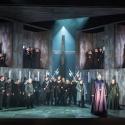
Moshinsky’s idea, simple enough in all conscience, was to locate Mascagni’s rustic chivalry in a stage Sicily of the purest Forties cardboard, but to do it so observantly and with such fresh intensity that the old-fashioned shone with a new light. The Potemkin sets, the chest-beatings and hair-tearings, the “realism” of choruses that, in Wagner’s memorable phrase, are “scenery that has learnt to march and sing,” the absence of anything that could remotely be called a “concept” – all these energised, rather than ossifying, a work that has survived because of them, not in spite of them.
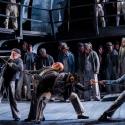
It still needs the best singers, however well fedLeoncavallo’s little masterpiece, which certainly does have a concept (we get it in Tonio’s homily before the curtain, though even this takes on a certain ironic focus in the light of his behaviour later on), was acted out on an empty stage, with a highly mobile choreography, a battered lorry for the commedia, “modern” – at least not 1890s – costume, and a Calabria that could be anywhere on the map.
Of course, Pagliacci isn’t exactly The Ring, though the score borrows from it often enough; isn’t intellectually open-ended, isn’t exactly intellectual at all. It still needs the best singers, however well fed, with a certain skill in making overacting look right, and these days WNO can supply these things in a way that I suspect they couldn’t have done in their amateur days of the forties and fifties.
In fact, this revival (by Sarah Crisp) shows that strong casting can even make Cavalleria rusticana act out like at least minor Verdi. When I first saw the piece at Sadler’s Wells in 1963, with the monumental (in every sense) Rita Hunter as Santuzza, I admired the voice but hated the character, with her endless, pointless moaning about her obviously worthless ex-lover.
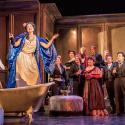
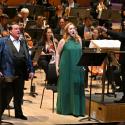
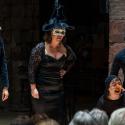
Camilla Roberts draws one into the character in quite a different way, with a warm presence and richly coloured tone – the best singing I’ve heard from this stylish performer. Gwyn Hughes Jones is a brilliant, uninhibited Turiddu, convincing in his shameless self-justifications, but even momentarily touching in his acceptance of Alfio’s (David Kempster’s) accusations. In fact the whole performance, with excellent support from Anne-Marie Owens (Santuzza in 1996, here Mamma Lucia) and Rebecca Afonwy-Jones (Lola), proves unusually coherent for a work normally regarded as the inferior partner in the bill.
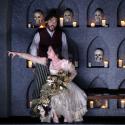
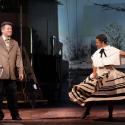
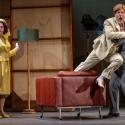
 Pagliacci gets a somewhat lighter touch. I at first had the feeling that Hughes Jones (pictured above trying to knife Meeta Raval) was holding back as Canio; it’s a tough doubling, after all. But the distinction in colour, the slight thinning of tone, was surely deliberate – different place, time, personality. And there was no compression in “Vesti la giubba” or in the transformation from grease-paint to blood-lust in the commedia. Kempster, a fine, elderly-looking Alfio in Cav, limps around malevolently as Tonio, his leg in a brace, other parts of the anatomy evidently fully operational. But Moshinsky imposes no sex as such, as his 2016 equivalent would surely do. Meeta Raval, a lively-voiced Nedda, gets her leg stroked, and that’s about it. How very 1990s! Gyula Nagy is a vigorous, personable Silvio, Trystan Llŷr Griffiths a smart, noticeable Beppe.
Both these operas are big on chorus, which is no doubt why they were chosen in 1946, and is certainly why they still do well on this much bigger stage. Whether standing and delivering in Cav or rushing around eagerly in Pag, the WNO chorus is top drawer, genuinely the best. The orchestra too. Carlo Rizzi conducts, as one would expect, with a fine feeling for the pace and varied density of these two quintessentially Italian works, now, like him, Welsh by adoption.