''…after various Accidents, it comes to pass that he recovers both Her and his Kingdom”. Handel's Radamisto may be a tale of warring kingdoms, noble self-sacrifice and mature, wedded love, but it’s also a fairly daft piece of dramatic belief-suspension, whose various knotty conflicts get miraculously untangled in a brisk few bars of recitative, just in time for a rousing final chorus and whatever the ancient Armenian version is of a nice cup of tea.
Director John Ramster is well aware of this, embracing the opera’s idiocies along with its musical glories in his witty new production for Guildhall’s students, and giving the opera’s awkward happy ending an unexpectedly plausible motivation in the process.
King Tiridate is at war with King Farasmane, whose son Radamisto must do battle to restore his father’s throne and protect his wife Zenobia, whose has caught Tiridate’s eye. To complicate matters further, Tiridate is already married to Polissena, none other than Farasmane’s daughter and Radamisto’s sister. Suffice to say, things get complicated.
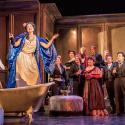
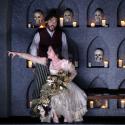
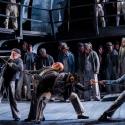
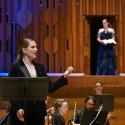
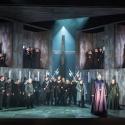
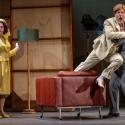
Louis Carver’s stylish designs (evocatively lit by Jake Wiltshire) place the action in a modern-day museum. Classical Horsemen line the back wall, rearing out of a sprawling bas-relief, while armies of business-formal clad stewards pace up and down in the foreground. Visiting the exhibition space are two warring heads of state, who settle down (rather unwillingly) to watch an operatic take on the gallery’s history. That a classic opera production like Ramster’s should mock the current trend for immersive, site-specific stagings so deftly is surely a sign that directors really do need to find a new gimmick.
The quality of the solo moments makes the general muddle even less explicable
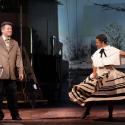
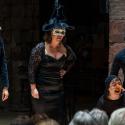
Within this neat dramatic frame, Ramster’s cast present performances that marry some nice contemporary comedy – plenty of da capo by-play, and a judicious use of a silent ensemble – with consciously old-fashioned costuming (painted-on beards and eyebrows and more headpieces and bangles than an am-dram production of Kismet) and baroque armography. There’s plenty of movement to drive things forwards, which is fortunate given how little impetus comes from Chad Matthias Kelly’s pit.
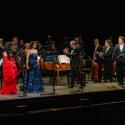
Despite the conductor’s best attempts to galvanise his forces, entries were missed or late, tuning erratic and the opening of arias frankly scary at times. The quality of the solo moments – the nimble violin in Polissena’s “Sposa ingrate”, and the deliciously coaxing oboe for Zenobia’s “Quando ma, spietata sorte” – makes the general muddle even less explicable.
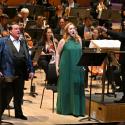
The cast coped well with the orchestra’s uncertainties. Jade Moffat’s luscious Zenobia swelled into something really exciting by the end of the evening – a richly upholstered mezzo, with plenty of colour running through it. Hers was a welcome foil to the many sopranos (not a countertenor in sight), led by Joanna Maria Skillett’s impeccable Tigrane – lithe and sparkling in her coloratura – and Elizabeth Skinner’s intermittently thrilling Fraarte.
If we could have done with something a bit richer for Radamisto, Chloe Traharne’s bright mezzo did the coloratura business, and Margo Arsane was an efficient Polissena, with a nice line in comedy. Dominick Felix got all the best laughs as unlucky-in-love tyrant Tiridate, and Bertie Watson added some much needed lower-voice heft with his crooning Farasmane.
Tied up in a neat bow of a dramatic conclusion (no spoilers here), Ramster’s production offers a lighter take on Handel’s tragicomedy than Christopher Alden’s for ENO, and provides a rare opportunity to hear the first version of a score later embellished with various replacement arias for Handel’s newly-arrived star Senesino. I’m not sure anyone will find it an improvement on the classic version, but as a curiosity it’s well worth seeing.
- Radamisto is at Milton Court until 12 June
- More opera reviews on theartsdesk