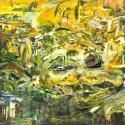
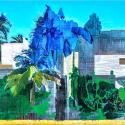
This exhibition of new work by Sean Scully is the latest in a series of encounters between contemporary artists and works in the National Gallery.
 Landline Pool, with its palette of blue and black, focuses on the expressive capabilities of the brush, a large house-painting brush on aluminium amplifying the gloss and texture of the painted surface. Each sweep of paint holds within it the energy of the brushstroke that put it there, just as in The Evening Star, visible brushstrokes remind us that what we see has not been conjured up, but put there by hand and eye. In Landline Star (Pictured right), the effects of colour laid one over the other take centre stage: Scully analyses Turner’s painting element by element, in a perpetual process of looking, painting and looking again.
The act of looking, rather than painting itself is underlined by Scully’s response to Van Gogh’s Chair, 1888, a painting that Scully first saw aged 17, and that provides the second major reference point in this show. He was struck by its workmanlike depiction of the textures and colours of tiles, wood, and woven fibres, qualities that, he says: “made it possible for me to think that I could actually make paintings.”
There is much to learn here of Scully’s own practice and his relationship to his forbears. Perhaps his paintings help us to see Turner and Van Gogh afresh. But if their strength is as commentaries on other people’s work, it is the fatal weakness that prevents them from being works of consequence in themselves.
- Sea Star: Sean Scully at the National Gallery until 11 August 2019
- More visual arts reviews on theartsdesk