Like certain other opera companies, WNO has leant in recent years towards popular shows of one kind or another. In their case this is not mere pandering to the Valleys coach parties, but a genuine attempt to assert an identity through an exploration of local south Welsh history.
Elena Langer’s Rhondda Rips It Up (2018) was a far from studious romp through the colourful life of the Newport suffragette Margaret Mackworth, Viscountess Rhondda. This time they have gone up-valley and, in Blaze of Glory, come up with a sparkling entertainment about the closing of coal mines in the 1950s and the miners’ defiant reassertion of their great male voice choir tradition.
Not only the subject but also the treatment, by librettist Emma Jenkins and composer David Hackbridge Johnson, are brilliantly adapted to the particular talents of WNO, with their wonderful chorus, many of whom can step out, as they do here, and bring style and presence to individual roles. I might add that they are no less brilliantly adapted to the Cardiff audience. Sitting in the mid-stalls of the Millennium Theatre at Friday’s performance, with supporting male choirs on either side, and the audience itself almost indistinguishable from the dramatis personae onstage, one was willy-nilly a participant. At the very end, with Rebecca Evans, alias Miss Nerys Price, conducting the audience in the final Welsh hymn, we were all together part of the Land of Song, and that was that.
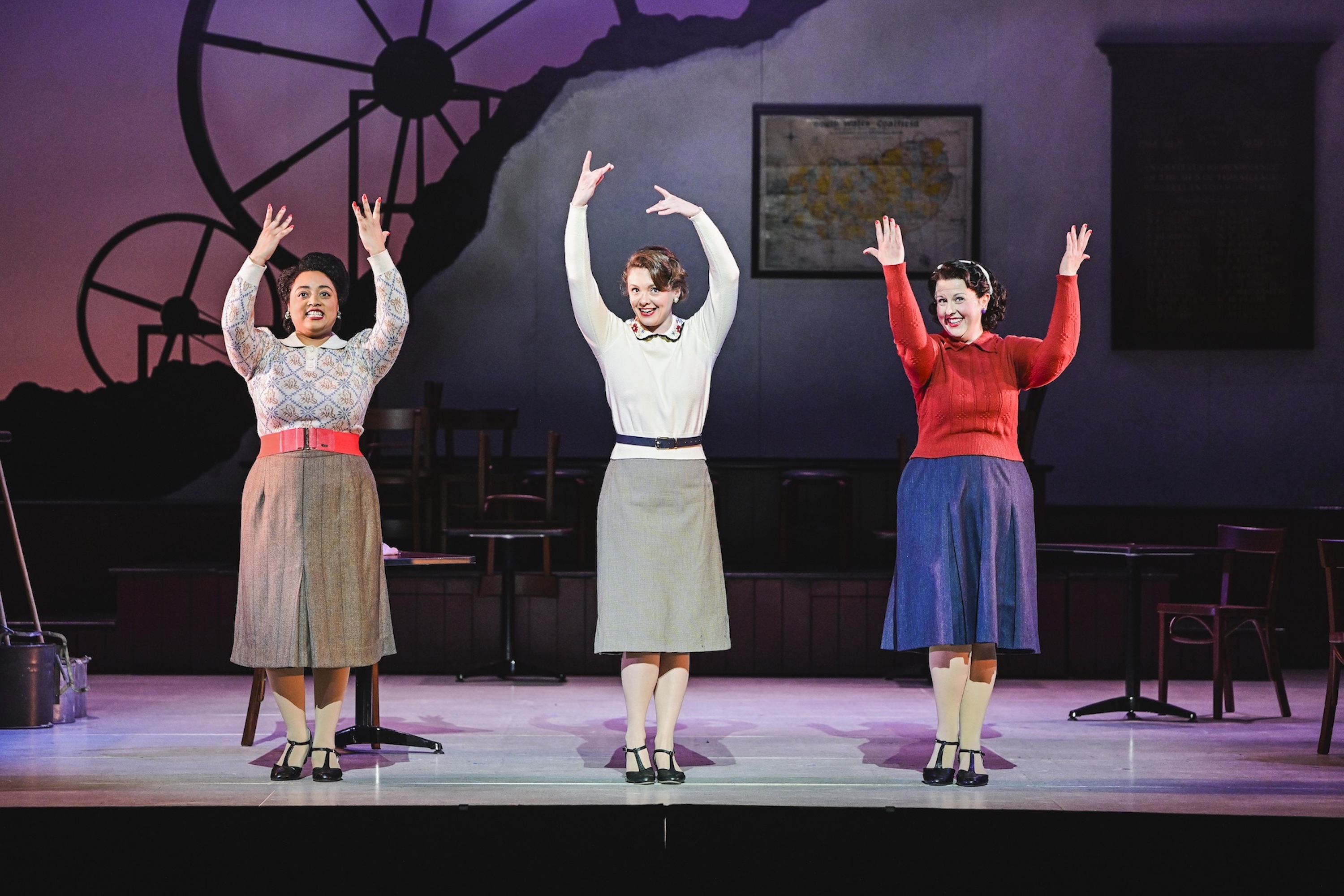
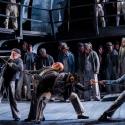
This is not to play down the professional skill involved in Caroline Clegg’s production and Madeleine Boyd’s neat composite stage design, that sets the social club, the practice room and the competition tent against the same ironic backcloth of the soon-to-be-obsolete pit winding gear. The story itself is simple enough. Depressed by the threatened closures and by the loss of some of his singers in a recent mining disaster, Dafydd Pugh – the pit foreman and former choir conductor – at first refuses, but is soon persuaded, to revive the choir in the form of a Glee club, and prepare it for competitions, in the last of which they triumph, just as the closure of their own pit is announced and Mr. Pugh collapses and dies of heart failure.
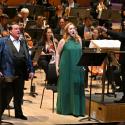
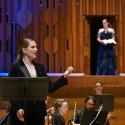
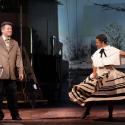
Miss Price is the choir’s accompanist and, as she announces at the start, “the love interest”; she also declares – on a stage full of women wishing each other Good Morning – that “this is a story about men.” Perhaps so. But women are more than prominent throughout. Rebecca Evans, all five foot of her, is perfection as the lovelorn but masterful accompanist, in love with Mr. Pugh, the towering and expansive Jeffrey Lloyd-Roberts. And stage and music are frequently dominated by a memorable Andrews Sisters spoof, in the form of an enticing trio of doo-wopping Bronwens (Angharad Morgan, Nafissatou Batu Daramy and Angharad Lyddon, pictured above).  But it is, of course, about the men: the choirs, and the individuals, notably Adam Gilbert, excellent as the youthful Emlyn, who persuades Pugh to take up his baton again but then leaves to join the Covent Garden chorus; Themba Mvula (pictured above with Rebecca Evans and Adam Gilbert to the right) as the Afro-American ex-GI who sings of how at home he’s been made to feel in the valleys; and Feargal Mostyn-Williams, as the yodelling brewer the Glee club poaches from Treorchy. Lloyd-Roberts himself is Pugh to the letter, shambling, absorbed, mildly patriarchal, a bit timid where the somewhat forward Miss Price is concerned. The whole picture is there, painted with precision, wit and huge affection.
Johnson’s score is to some extent a clever compilation. It incorporates Welsh hymns, and French competition pieces by Ambroise Thomas and a certain Laurent de Rillé, embedded in a sort of pastiche forties/early fifties jazz with memories of Rodgers and Hart, beautifully, expertly orchestrated, the joins skilfully disguised, the pacing generally sure. Stephen Higgins conducts with style, the playing is impeccable. My one grumble is that the spoken dialogue is often inaudible. But, with surtitles on parade, this is not too damaging. The music and the people, anyway, are the thing.