Fascinating for the history of opera, less so for opera. The most interesting thing about Gazzaniga’s take on the libertine and the stone guest, apart from a couple of sprightly numbers, is the libretto by Bertati, repurposed with better dramatic shape by Da Ponte for Mozart, whose masterpiece opened in Prague eight months after the lesser work’s Venice premiere of February 1787. We have a right, though, to witness Gazzaniga’s unadulterated original. This wasn’t it.
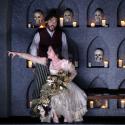
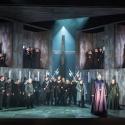
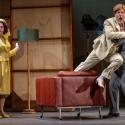
For most people in the audience, the first surprise – apart from discovering that the opening scene is Mozart/Da Ponte’s in embryo (Marcus Swielicki as Don Giovanni, Alexandra Dunaeva as Donna Anna and Daniel Barrett as Pasquariello pictured below) – was to hear Pasquariello, the servant in Bertati’s version, come out with Leporello’s Catalogue Aria – apparently what happened when the opera arrived in London, but wouldn’t it have been better to hear the source, a milder listing interrupted by the shocked Donna Elvira? Daniel Barrett, a rich bass-baritone in the making, sang it well, but the assumption would have been that he wanted something more rewarding than the Gazzaniga original.  Folk would have been less aware, unless they’d read their programme, that extra arias by Salieri had been inserted to flesh out the responses of Giovanni’s victims, or, in the words of director Louise Bakker, "to explore the plausibility of the contexts of the other characters more fully” – not really the point of Gazzaniga’s and Bertati’s one-dimensional storytelling, even if it gave the young performers more to sing. Of the additions, you might have guessed the second aria for Biagio, the Masetto character, was sophisticated beyond Gazzaniga’s reach; Sam Hird delivered it well.
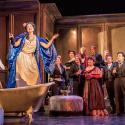
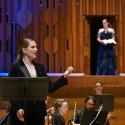
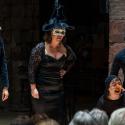
What’s striking about the Gazzaniga score? The earthiness of the peasants’ entrance number and the finale, with its amusing introduction of solo instruments; the cats’ duet between Donna Elvira and Maturina (the Zerlina character), with its laugh-out-loud insults of “sardella” (“sardie”, Elvira to Maturina) and “polpetta” (“meatball”, Maturina to Elvira), confidently delivered by Madeline Barham (pictured below) and Charlotte Jane Kennedy, making their only showing in last night’s cast; the text of Elvira’s first aria (essentially, “we women are called fickle, but it’s men who are much more inconstant”) and the virtuosity of the second, winning Barham the laurels as the most promising voice of the evening.
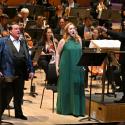
 But then others didn’t really get much of a chance to shine. Gazzaniga's Donna Anna (Alexandra Dunaeva) sings no more after the opening scene; a fourth lady, Donna Ximena (Ellen Pearson), could easily be discarded (weirdly, you could cast the same soprano as the three aristocrats, but that wouldn't have done in sharing the honours for a student production). The two tenors, Marcus Swielicki as Don Giovanni (no baritone in Gazzaniga) and Sam Harris as Don Ottavio sang well but sometimes stood less confidently (or as my guest put it, didn’t own the stage, the sign of youthful inexperience and maybe a legacy of the Covid era).
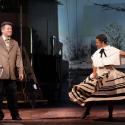
Bakker’s staging allowed us to take the notion of attempted rape upon Donna Anna seriously – as it always should be, and may now remain so in the era of post-chauvinist directors – and Becky-Dee Trevinin’s period costuming highlighted the gulf between the aristocrats and the peasantry, though Pasquariello shouldn’t have been allowed to keep touching Donna Elvira up. The clean look of the stage was intermittently spoiled by inelegant arches and doorways moved around (we could easily have just imagined them).
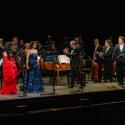
The Commendatore on his monument and at supper was well enough handled, backed up by the resonant bass of David Fraser. And the dinner alla casa Giovanni was enlivened by an excellent cameo from Benedict Munden as the disgruntled cook. Confident dancing in Alex Gotch’s choreography at the end, too, and lively conducting throughout from Michael Rosewall, keeping the manner going when the matter was less than distinguished. But I’d still be up for presentation of the authentic Gazzaniga one-acter, sans interval, or maybe with Gluck's truly original score for a ballet version preceding it.