This fascinating American documentary tackles the societal and medical treatment of the 1.7% of people born with intersex traits that leave them with sex characteristics (chromosome patterns, genitals, gonads) that aren’t obviously male or female. These people are the ‘I’ in the LGBTQI+ acronym.
We meet three charismatic and impressive campaigners who have intersex conditions.Their life stories are riveting, their arguments persuasive. Political consultant Julia Roth Weigel was born with XY chromosomes and instead of ovaries had testes, which were removed in childhood so the doctors could call her female. PhD student and campaigner Sean Saifa Wall (below) comes from a family where partial androgen insensitivity syndrome affected not only himself but other relatives. As a child he was told he was a girl, even when he felt he was a boy. The third person is River Gallo, who was born without testes but put on testosterone at 12 to make them a boy.
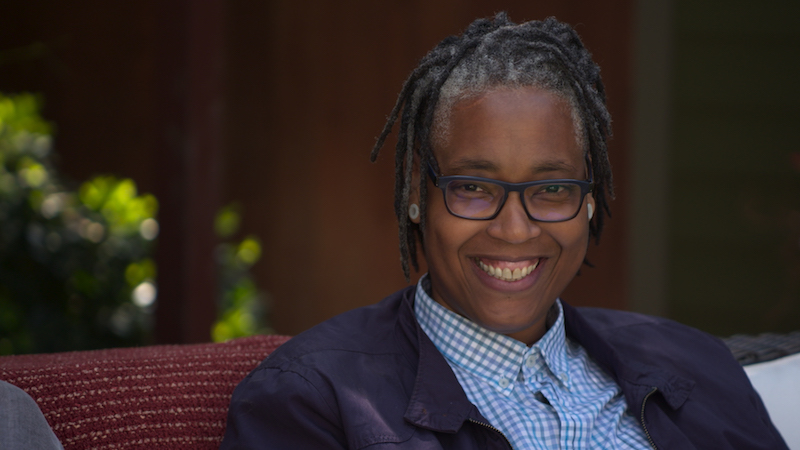 All three interviewees maintain that surgical procedures in childhood were performed, and hormone treatments enforced, without their informed consent. Social conventions and pressure put upon their parents by the medical establishment led to interventions that they would not themselves have chosen.
All too often, they contend, such practices have led to unhappy adult lives. They argue the case for allowing (and celebrating) children born with intersex conditions and letting them choose in adulthood if they want to go down a medical or surgical path or remain as they were born.
Veteran documentary director Julie Cohen has made documentaries about Ruth Bader Ginsburg and Julia Childs and knows how to make complex subjects accessible to an audience. She was invited to look through the US broadcaster NBC’s huge factual archive to see if there were topics to which the network could return. She found the out-takes of an interview with a young Canadian man, David Reimer, who was the victim of a horrific surgical accident in babyhood that led to a misguided and falsely represented psychological experiment.
In 1966 Reimer was one of two twin boys undergoing circumcision that left him so mutilated that his parents were advised to bring him up as female. His parents took the advice of John Money, a charismatic psychologist at one of America’s leading research hospitals. Professor Money was the key proponent of the theory that if intersex children were brought up in what he described as their ‘optimum gender’ all would be well. More genital surgery was performed on Reimer and he was given a girl’s name and hormones at puberty.
Money published papers claiming that all was well and the child was living successfully as a girl, when in fact he was extremely unhappy and did not feel feminine at all. Reimer finally learnt the truth from his parents when he was 14 and chose from then on to live as a boy. He went on to marry and adopt his wife’s children, but deep and lasting psychological damage was done.
Over the years the Reimer/Money case has been turned into books, magazine articles and several television programmes both in the US and UK. But seeing Reimer’s distress in this new documentary is heartbreaking; a fragile, shy young man who one feels would never otherwise seek media attention, tells us his story on camera to “save other people from going through what I went through”. Reimer was a victim not just of an incompetent surgeon in babyhood but a psychologist who put the fame he garnered out of a cruel experiment above the needs of a vulnerable child. The documentary Three Identical Strangers told a similar story of American psychologists, obsessed with the nature/nurture debate, who carried out unethical and cruel experiments on young children's lives in the 1970s but with rather more style and suspense than Every Body manages.
Instead Julie Cohen gives us a whistle stop tour of the historic treatment of intersex people – from the hermaphrodites of ancient history to bearded ladies in travelling freak shows. Most of her documentary though is spent in the company of the three captivating young activists she met during her researches who campaign for greater awareness and acceptance of intersex people and less medical intervention in childhood. There’s a delicate balancing act to navigate here because many in the trans rights movement argue for allowing children unhappy with their gender to take cross-sex hormones pre-adolescence in order to transition to the desired gender before the undesired adult sexual features (Adam’s apples, breasts, musculature) have developed.
There’s an inherent conflict in the view that decisions about intersex children should not be taken by their parents and medical professionals but by the person themselves when they are old enough to understand that their choices will affect the rest of their lives, while trans activists posit that children who do not have intersex conditions (but are unhappy with the sex they were born with) should be allowed to make decisions while underage on similar procedures. It’s one of those "light blue touch paper and retreat" debates that play out on social media. But that shouldn’t put anyone off seeing this energetic and well-meaning documentary which could well play as a companion piece to the recent Is There Anybody Out There?, a British documentary which also argues for allowing children who are born with physical differences to be left to choose what interventions they desire.