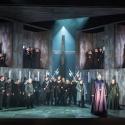
Emotional truth is elusive in Tchaikovsky’s “lyrical scenes” after Pushkin’s verse-novel. Overstress every feeling, as conductor Henrik Nánási did last night, and you leave some of us in the audience feeling manipulated. Play it cool, which is what we mostly get in Ted Huffman’s new production, and the heart is similarly untouched.
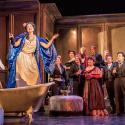
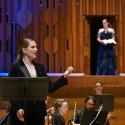
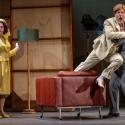
There shouldn’t be a problem with modern dress – mostly stylish and colour-co-ordinated from costume designer Astrid Klein – even if here it doesn’t give us a sense of place (Hyemi Shin's grey stage leaves room only for a few props). That wouldn’t matter if the intensity of feeling in the main characters – above all young Tatyana and supposedly devastated older Onegin, who loves her too late – were present to match Nánási’s insistence. Just one example: as Nánási’s orchestra throbs Tatyana’s uncontrollable passion at the start of Tchaikovsky's famous Letter Scene, soprano Kristina Mkhitaryan shows us nothing like the same in her body language (think back to Elena Prokina for Graham Vick, Ekaterina Shcherbachenko for Dmitri Tcherniakov).  Mkhitaryan is vocally stunning, with a full, fearless and luminous upper register, but nothing less than lived realisation of adolescent extremes will do. Huffman’s glosses would work better if those extremes registered: unbridled Olga coming in to take dictation as Tatyana composes her love-letter to Onegin (Mkhitaryan and Avery Amereau pictured above), then caught at the beginning of the party scene virtually in flagrante with him, a duel scene which ends, let’s just say, not in the usual way.
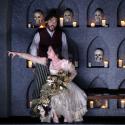
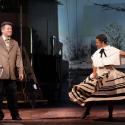
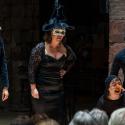
Much is delivered at the footlights, Onegin presenting himself with a bow and Lensky signing off with one before taking a chair at the back of the usually empty stage, so Lensky’s aria certainly works in the ideal delivery of Liparit Avetisyan (pictured below). Brindley Sherratt, a late replacement as Tatyana’s older husband Prince Gremin (who is nothing but an aria, yet what an aria), gave a masterclass in bass delivery. Others fail emotionally because of Nánási's extreme tempi: way too slow for the fragile heart of Tatyana’s big scene, too fast for Onegin’s rejection, which gives us nothing of the 19-year-old’s struggle to find his soul and denies Gordon Bintner a legato sheen (it’s always fascinated me that the line here is a more curtailed version of Tatyana’s deepest confessional).  Tchaikovsky doesn’t make it easy for the nominally main character, focusing on Tatyana in Act One, Lensky in Act Two and Onegin only in Act Three. But Bintner simply comes across as a cold fop, a kind of Bentley Drummle with correct social graces (three air-kisses to all, nicely mirrored in Act Three), and then as a returning wanderer seven years later hardly marked by his experience. On the first night, at least, the passionate final scene was too much for him; unlike Mkhitaryan and Avetistyan, he lacked power at the top of the voice.
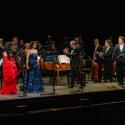
Perhaps the best acting comes from Avery Amereau’s crucially enlarged role as the fickle sister, later warder of Tatyana’s two children (another perfectly fine gloss). Among the smaller roles, only Jamie Woollard’s second at the duel, Zaretsky, is ideally strong; as clown Triquet at Tatyana’s name-day party, Christophe Mortagne sounds stretched, but again Nanasi’s slow speed for his couplets doesn’t help.  The “peasants” in Act One sound too English, but all the song-and-dance scenes are well enough choreographed by Lucy Burge, albeit with obvious spotlight on the professional movers. Nánási always gets a vivid sound from the Royal Opera Orchestra; the Waltz and Polonaise have real vivid dash. Why, though, does Huffman favour the Ecossaise of Tchaikovsky’s revision for a big Imperial Theatres staging when the original would serve his avowal of stripped-down music drama much better? It’s one of many anomalies in a disappointing evening,