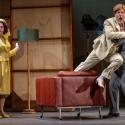
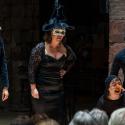
What does it mean to have a voice? And what does it mean to lose it? Those are the questions the award-winning Sound Voice Project has explored – through research, collaboration and live performance – since its beginnings in 2016. The latest incarnation of composer Hannah Conway’s project is as “immersive digital opera performance installation”.
Down in the bowels of the Royal Opera House, as far away from the hum and chatter of the foyer crowds, the massed voices of the main auditorium, cocooned in an artificially darkened, shrunken Linbury Theatre, we’re invited to meet people whose voices have been taken away by illness. On three parallel screens, each person (or group of people, in the case of the Shout at Cancer Choir – the world’s first specialist laryngectomy choir) is projected alongside a musical alter-ego, their own voice and sound duetting with opera singers Lucy Crowe and Roderick Williams, strings, piano and digital audio. It's a deliberately disorienting experience. Black and white videos (created by Luke Halls) are sometimes doubled across the screen, sometimes take on independent life, a flickering visual counterpoint that comes in and out of unison focus. Faces meld and drift, doppelgangers are established and held in tension, human faces shrink and multiply to form a single roaring digital mouth.
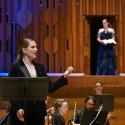
But these are stories principally told through sound – or its absence. The empty husk of Tanja Bage’s voice, her voice box removed in 2020 after cancer was found behind her vocal cords, rubs up against not only Crowe’s liquid-beautiful singing, but also Bage’s own voice “before”, recorded in a short video for her young children; Paul Jameson’s ululating utterances (his voice lost to Motor Neurone Disease) shapeshift into Roderick Williams’ supple baritone in duets that occupy the space between music and sound (Paul and Roderick pictured above); the choir’s breathy, whispering voice-ghosts coalesce into synthesised melody and song.
The stories speak for themselves (the irony isn’t lost), the testimonies profoundly moving. But is there any added value in the installation? Participants have spoken of their responses, of a sense of regaining personhood and empowerment, but as a piece of public art I’m less convinced. Perhaps it’s a question of context. This project has nothing to do with opera. Conway’s music (setting words by Hazel Gould that draw heavily on verbatim testimonies) is music theatre by way (in the case of “Paul”) of Butterworth and Finzi, choral Americana in “I Left My Voice Behind”, and an anonymous contemporary lyricism in “Tanja”. Williams and Crowe sing expressively, but it’s not enough. In an art gallery this might not be a problem, but in an opera house, billed as a “radically different kind of opera experience”, it sets up unhelpful expectations that the piece itself has no interest in fulfilling.
Rather than buying in three ready-made chamber pieces from a previous iteration of the project, why not commission a new work connected more directly to opera? This feels like a lazy repackaging of pre-fab product, leaving the audience to make the final leap between the questions it introduces and the specific milieu. What does it mean to sing, and to sing opera? Drama, narrative, a heightened expression of emotion, of self, a sonic means of inhabiting a space. All these ideas were left untouched by the installation. Ultimately opera is about the live experience of the human voice – unmediated and unamplified. If you want to explore what voicelessness feels and sounds like in the context of this particular art-form, that might be a good place to start. Digital art has its place, but it’s not in the opera house.