Tchaikovsky has precisely two operas in the standard repertoire (including The Queen of Spades, currently playing at Garsington), and readers who love those works might well be forgiven for wondering what happened to the other eight or nine. On the evidence of Grange Park’s Mazeppa, the answer might seem to be pure mischance.
In David Pountney’s production it comes across as a powerful, moving, often inspired drama, if not without certain problems that Tchaikovsky might have addressed if he hadn’t had the disconcerting habit of falling in love with his own characters.
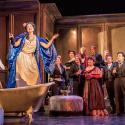
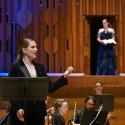
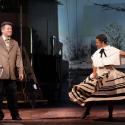
At bottom, the work is a gripping study in the eternal conflict between love and politics. Forget Liszt’s symphonic poem about the cuckolding philanderer tied naked to a galloping horse. Tchaikovsky’s Mazeppa is the historic hero of Ukrainian separatism who, late in life, broke with Peter the Great, allied himself with the Swedish king Charles XII, and came to a sticky end at the Battle of Poltava in 1709. Unfortunately for nationalism’s good name, Pushkin’s brilliant poem on the subject – Tchaikovsky’s source – revealed him as a vain, self-serving tyrant who tortures and kills his too-young lover’s father for opposing their marriage, while picking an unwinnable fight with the Russian crown. 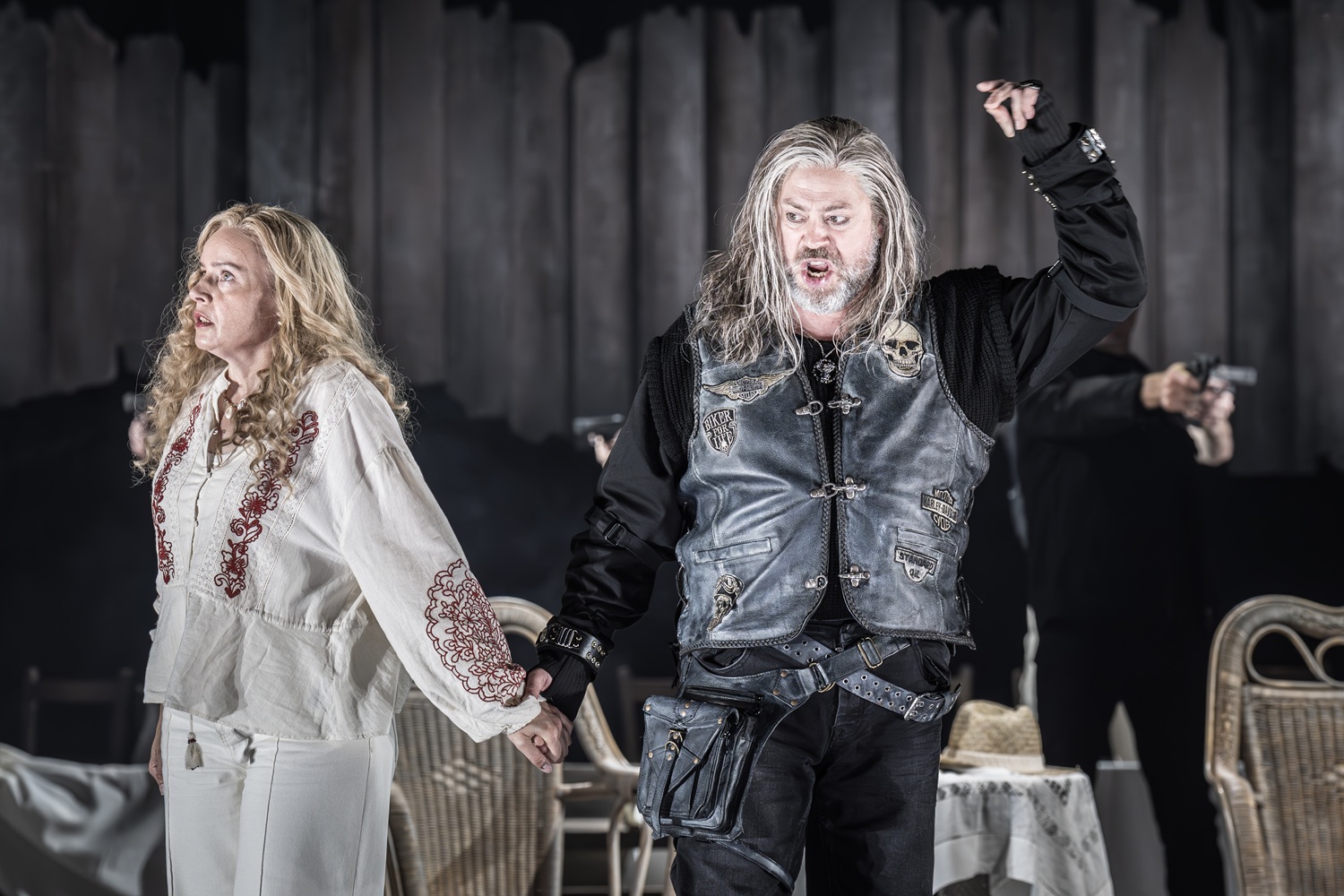 The subject gave Tchaikovsky trouble, no doubt partly because of its emotional contradictions: the girl Maria, prepared to abandon loving parents for an elderly biker (Pountney, updating, gives him at one point an actual motor-bike with Maria up behind); Mazeppa himself, sage and reflective, yet vengeful and cruel. The questionable solution is to introduce a rejected tenor lover, Andrei, hinted at but unnamed by Pushkin, and have him dominate the first and last scenes of the entire opera. Andrei’s long duet with Maria in the first scene, beautiful in itself (and superbly sung with Rachel Nichols by John Findon), seriously unbalances the start of the drama, just as his protracted death in the last scene drags out its conclusion. (Pictured above, Mazeppa with Maria)
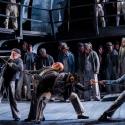
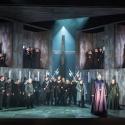
Yet there is so much to relish at the work’s core that one accepts Tchaikovsky’s musical love affairs as a sort of unearned bonus. Mazeppa’s musing, like a rustic Prince Gremin, on the delights of love in old age, his violent quarrel with Maria’s father, Kochubey, marvellously directed by Pountney, above all the richly ironic scene where, almost in the same breath, he orders Kochubey’s execution and reveals to the now-pregnant Maria his plan for an independent Ukraine with him as its ruler: ironic because Maria is unaware of her father’s fate and learns of it only later in this same scene from her mother. This whole sequence is managed by Tchaikovsky with amazing dramatic flair and insight, a clear notch up in this respect from anything in the earlier Eugene Onegin (on the whole, admittedly, a less flawed work). (Pictured below, Kochubey and his friend Iskra (Sam Utley) about to be executed)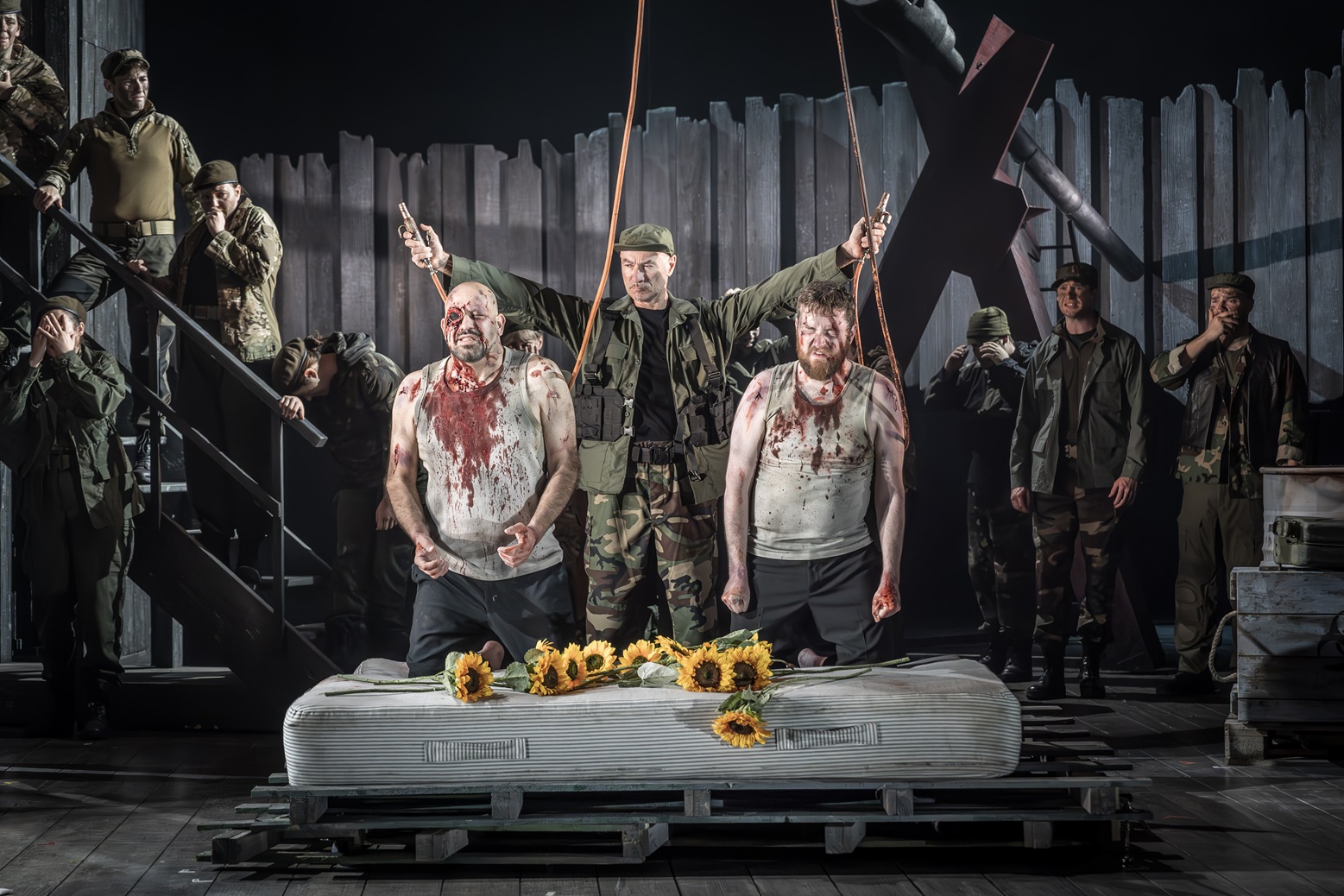 Apart from the inevitable fringe Pountneyisms – the motorbike, the array of coffins in the battle interlude, out of which step a platoon of gas-masked dancers; above all the unappetising teeth-pulling and eye-gouging on the stroke of the dinner interval – this is a production that makes a serious and thoughtful case for an unjustly neglected opera. Francis O’Connor’s sets, slatted timber structures alleviated now and then by coloured mobiles, get the flavour of deep Ukraine even when his costumes and disagreeable relevant hardware imply a perhaps vain aspiration to modernise. Lynne Hockney’s choreography of those wonderfully Russian episodes, the girls’ flower-wreathing, the gopak, etc., where Tchaikovsky was so in his element, is watchable and idiomatic.
Above all (and this might be an issue), Mazeppa would be unimaginable undercast. Here it certainly is not. David Stout sings the title role with a fine mixture of lyricism and ferocity and Luciano Batinić is a terrific Kochubey, bold and direct, a father not to be meddled with, though it earns him a particularly nasty reward. Rachel Nichols, a little gusty in the opening duet, grows in stature as her world disintegrates, and Findon, though a somewhat wooden actor, is a big, rangy tenor, a Lensky gone heroic. Even minor roles turn out not to be. Sara Fulgoni is deeply moving in her crucial scene trying to explain Kochubey’s fate to her confused and distraught daughter, and – on the other side of the coin – Andreas Jankowitsch makes the torturer Orlik as sadistic as Tchaikovsky, who gives rather few directions on this point, allows – that is, very.
The orchestra is that of English National Opera, on top form in Tchaikovsky’s consistently inventive score (woodwind writing especially unmistakable), and well conducted by Mark Shanahan, who paces this complex and multi-facetted work with great assurance. Mazeppa is a dark, remorseless drama, but with many flashes of colour and a strongly beating heart. It deserves this reassessment.