It’s a good year to be Handel-lover. No sooner have summer runs of Rodelinda (Garsington) and Saul (Glyndebourne) finished than we’re into autumn and Opera North’s Susanna, Giustino at the Royal Opera’s Linbury Theatre, with Ariodante still to come on the main stage.
Outings of Susanna don’t come around every day, but Giustino is a proper back-of-the-cupboard rarity – a lighter affair than the big opera serias, short on da capos, and long on supernatural silliness. Throw in a long-lost brother and a bear, and this freely fictionalised account of the rise of sixth-century Emperor Justin I is much more fun than a Classical biopera might sound.
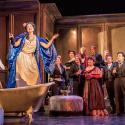
Ploughboy Giustino works the land but dreams of glory and military triumph. Luckily Fortune is on his side, and when he rescues Emperor Anastasio’s sister Leocasta from a bear it sets in motion a series of adventures that see him rescue the Empress Arianna from a sea-monster, capture the enemy Vitaliano (first rewarded and then imprisoned for his troubles), before the true villain Amanzio is unmasked and Giustino elevated to co-regent. Making his Royal Opera debut, director Joe Hill-Gibbins strips the piece of its supernatural elements. What, after all, are monsters and gods but dramatic outsourcings of human desires and agendas? So the sea-creature is revealed as three men in a (metaphorical) trench-coat, and the bear is scheming Amanzio in disguise. Even La Fortuna here becomes Arianna herself, taking an active (and sequinned) role in summoning her new champion.
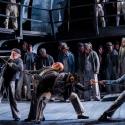
Designer Rosanna Vize reminds us of the size of the Linbury stage, using the full width and depth to create a quasi-Mediterranean courtyard, dominated by a mural with Fortune’s wheel in the foreground, and a series of ropes and pulleys. As human fates wax and wane, so a circle of suspended lights right and fall. It’s simple, visually effective stuff, and leaves plenty of space for the chorus of Guildhall Students – a white-clad troupe of accolytes – to busy themselves in making a drama whose every costume-change and illusion happens on stage in full view. David Bates’ La Nuova Musica are all zest and sway and surge in the pit – what a joy to hear a proper period band in this house – pacing the musical drama fast enough to motor over the thinner moments of plot while still lingering over the emotional meat of the action. There are some gorgeous musical moments: an Overture with a dazzling almost-oboe-concerto embedded in it; gorgeous duet “Mio ben Tesoro” for reunited Emperor and Empress; Giustino’s “Zeffiretto, che scorre nel prato” with its lilting pair of recorders; the pointillist birdsong of Leocasta’s “Augelletti garruletti”. Bates and his band sell not only those, but the more workaday moments between.
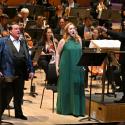
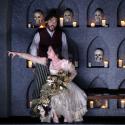
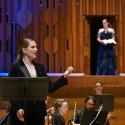
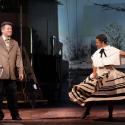
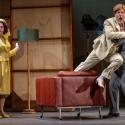
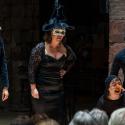
Casting reverses Handel’s original scheme: mezzos Polly Leech and Keri Fuge sing Giustino and Anastasio respectively (both written for castrato) while countertenor Jake Arditti is a snarling Amanzio (originally a contralto). There’s an embarrassment of lower-voice riches here, a full spectrum of altos starting from the oaky weight and smoothness of Leech’s voice – wonderfully true and sweet – and moving up through the austerely handsome depth of Esme Bronwen-Smith’s Leocasta (pictured above with Leech) and the greater scope and brilliance of Fuge – dazzling at the top – to arrive at Arditti’s Amanzio, silvery and nimble. Doubling as Arianna and La Fortuna, Canadian soprano Mireille Asselin (pictured above with Fuge) is rarely off the stage. Dispatching tidy coloratura in a variety of challenging frocks and situations she holds her own, but her piquant soprano can’t quite deliver the weight and expressive compass the role demands, out-gunned by Fuge’s more expansive delivery and physical comfort on stage. Having Ben Hulett (Vitaliano) and Jonathan Lemalu (henchman Polidarte) in supporting roles feels deeply luxurious, adding enough gravitas to root this charming melodrama in something real and human.