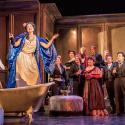
What a load of balls. No, seriously. Globes, orbs, moons, suns, juggling balls, beach balls, er balls balls: if it’s spherical and pregnant with symbolism then you’re bound to find it somewhere on the props table for English National Opera’s Akhnaten. At the centre of Phelim McDermott’s new production of Philip Glass’s opera is a troupe of jugglers. If that idea appals you it’s worth suppressing your doubts, because it turns out that the greatest trick on display in this mesmerising show isn’t ball skills at all, it’s conjuring – dramatic sleight of hand of the most sophisticated, bewitching kind.
ENO and Philip Glass have a long history, and recently McDermott – artistic director of theatre company Improbable – has become a regular part of it. But where his Perfect American couldn’t find that Disney magic, and his Satyagraha stumbled under the weight of too many ideas, his Akhnaten has tapped into something very special, all the more so for being completely unexpected.
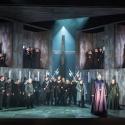
The stage pictures that McDermott and designers Tam Pye and Kevin Pollard create here are startlingly lovely
If the juggling sounds like a gimmick, then it doesn’t read at all like one in a production that takes a Robert Wilson approach to visual ritual and repetition. Performed by Gandini Juggling, the elegant sequences of movement become a surprisingly expressive metaphor for the mystical power of Akhnaten’s new religion. We understand his fascination with the sun because we share it, unable to draw our eyes away from something we too are captivated by, but cannot fully grasp. Only very occasionally do we stray into Cirque du Soleil territory. A spontaneous burst of applause in Act II signals that thrills have briefly overpowered drama.
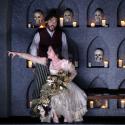
 The stage pictures that McDermott and designers Tom Pye and Kevin Pollard (sets and costumes, respectively) create here are startlingly lovely. Whether it’s the sun, flushing through the spectrum of colours during Akhnaten’s aria, or the loin-tighteningly sensual duet for Akhnaten and Nefertiti, weaving and winding themselves up in fleshy skeins of material during their duet (the natural heirs to Ligeti’s Spermando and Clitoria) there’s a loving care for detail here that makes the slow pace of movement and the gradual, incremental shifts of musical patterning a meditative delight rather than a frustration.
It helps that, unlike Satyagraha, the repetitions and ritual of Akhnaten remain largely abstract (ghastly spoken text aside), free from the mystical pseudo-profundity that so exhausts in the earlier work. There’s religion, certainly, but no preaching. In many ways this third panel in Glass’s “portrait” trilogy is closer to Einstein on the Beach, though more musically fluid, more yielding in its ostinatos and (despite the lack of violins) more varied in its colours.
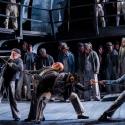
Visuals glance towards Egypt without feeling bound by it, and the result blends metallic, industrial minimalism with richly textured fabrics and headdresses – the very model of a modern Egyptian Pharoah.
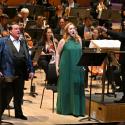
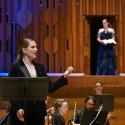
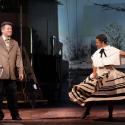
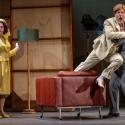
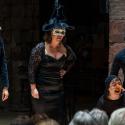
 Beguiling in his intensity, Anthony Roth Costanzo (pictured above right) makes a monarch worth converting for, Tiresias-like in his fluid sexuality. If his laser-point tone won’t be for everyone, bringing with it a certain sourness of pitch before the release of vibrato settles the note, there’s no arguing with the vocal power he brings, holding his own above even Glass’s thickest textures. But while his “Hymn to the Sun” is compelling, it’s in ensembles – the duet with Emma Carrington’s generous-toned Nefertiti, and the trio with Carrington and Rebecca Bottone’s radiant Queen Tye (pictured above with Zachary James) – that he really shines. Despite negotiating some ghastly English text, Zachary James has tremendous power and presence as the Scribe, translating this parable down the ages for us.
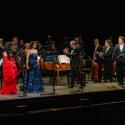
The ENO chorus once again prove their worth, making the most of Glass’s monumental writing while singing in Akkadian and Hebrew and even doing a little elementary juggling. Conductor Karen Kamensek finds just enough space for poetry within the rigid architecture of Glass’s music, shaping a reading that never insists upon its own loveliness, and is all the more beautiful for that.
Already the best-selling contemporary opera in ENO’s history, this Akhnaten is a timely reminder of just what the company is good at, and just how damn good they are at doing it. It’s an argument more powerful than any amount of figures or rhetoric for the ENO’s survival, and should be mandatory viewing at Arts Council England.
- Akhnaten at ENO until 18 March