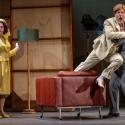
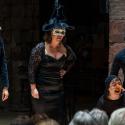
I do wish that arts institutions would stop using the word “immersive” when they simply mean “staged”. Just to be clear, there is nothing “immersive” about Netia Jones’s new staging of Georg Friedrich Haas's song-cycle ATTHIS at the Royal Opera House’s Linbury Studio, whatever the blurb may say. The director’s signature video projections, dance, song and music, come together to create an exquisite, hypnotic piece of very traditional theatre – not a promenade or a broken fourth wall in sight. And it’s all the better for it.
Last seen taking over the Barbican for the psychedelic fantasy of imagination that was Unsuk Chin’s Alice In Wonderland, it’s good to see Jones working with simpler materials, distilling her restless creativity down to something cleaner, albeit no less meticulous. Painting with the endlessly flexible canvas of video – used here as an extension of the shadow-play of her lighting – Jones is a natural visual counterpart to Haas, whose microtonal music occupies the same range of shifting, incremental textures.
Barely an hour of music-theatre, both light and rich
It’s no exaggeration to say that Haas is working in a harmonic language all his own. While conventional Western music might employ a hundred or so pitches (if you consider the full range of all orchestral instruments), Haas’s opera Thomas demands no fewer than 1,600. The results are luminous and alien, texturally anchored in the familiar, the traditional, but stretched beyond any recognisable elastic limit of harmony.
 Haas’s Second String Quartet – a single, continuous gesture of a movement – actively engages in this playful conversation between tradition and experimentation. Here it is repurposed as the prologue to Haas’s 2009 song-cycle or monodrama for soprano and octet (scored, deliberately, as Schubert’s own) ATTHIS. Setting a sequence of fragmented texts by Sappho, the cycle pieces together a failed love affair between the poet and her beloved Atthis, whose name survives in various scraps of verse.
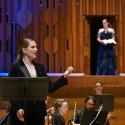
The result is barely an hour of music-theatre, both light and rich. Jones’s monochrome set is dominated by a giant suspended moon (a nod, surely, to Pierrot Lunaire, lurking alongside Erwartung in ATTHIS’s frame of reference) – a sole point of stillness among shifting, living light, playing against the oil-slick of a floor and over the face and body of soprano Claire Booth, suspended above the stage.
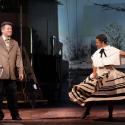
Jones takes Haas’s love-story-in-reverse (ATTHIS moves from abandonment and anger to memories of first passions) and mirrors it in her prologue. Two dancers (Laure Bachelot and Rachel Maybank) take the roles of Sappho and the young Atthis the Tadzio-esque object of her affection. We follow them from first meeting to violent parting, played out in a series of choreographic fragments, narrative miniatures echoing the fractured bursts of Haas’s music, the sudden shafts of melodic light that flash out among his microtonal slitherings.
 In the confrontingly small space of the Linbury it was a surprisingly polite, innocent courtship, rewritten later in soprano Claire Booth’s extraordinary performance into something altogether wilder and more elemental. Booth (pictured left and above) is an intensely watchable performer, responsible for translating so many contemporary works into emotional language an audience can understand. Here she tackled Haas’s extreme vocal writing with complete conviction, delivering what is often instrumental rather than vocal technique with awareness both of her role as another texture in the ensemble, and with the dramatic command demanded by this still, music-driven production.She is strongly supported by musicians from the London Sinfonietta, conducted sensitively by Pierre Andre Valade.
Haas and Jones’s collaboration is a beautiful one, tender with humanity while chafing hard at the emotions. It makes the recent announcement of a mainstage opera for Haas at the Royal Opera next season (Morgen und Abend) all the more exciting – another chance to see this arch musical manipulator and dramatist at play.