In fact it was the Namur Chamber Choir which had the lion's share of the most striking music, transcending pretty hymns of celebration to conjure up for us the dark magicians who create the tripartite chimera, striking haut-contre tenors crowning their sombre harmonies, and then the fearful people of monster-ravaged Lycia. For these alone Rousset deserves the royal crown for resurrecting a score that disappeared from sight after 1773, its last court flourish following the 1679 premiere in the Academie Royale de Musique. It's not just the similarities with the myth of Idomeneo that made me wonder whether Mozart could possibly at least have seen the score of Bellerophon, for it's nothing less than his admittedly greater ceremonies which Lully's Acts Three and Four evoke. Rousset confessed his surprise when he laid his hands on the printed edition (pictured above), a love at first sight which gave rise to the first performance "in modern times", as they say, at this year's Beaune Festival and now at Versailles.
Rousset's elegant but never brittle approach, slipping into lilting metres without fuss, phrasing beautifully and seeing to all the varied dynamics, kept our interest stoked (no mean achievement in my case, as I'd risen at 4.30am for the flight to Paris, but never nodded once). It all projected effortlessly in the glorious wooden theatre right to the back of the king's box. The five basses de violon kept the foundations powerful but sprightly; oboes doubled stylishly with violins and Marie-Ange Petit wielded an exotic array of percussion to freshen up the Bacchic and Eastern dances. If vocally the ensemble was less perfect, three of the four leads kept us engaged. Ingrid Perruche regally dominated as Sténobée, the imperious queen whose original role in the myth as a kind of Potiphar's wife is beefed up by her jealousy of Bellérophon's beloved Philinoe (a more than usually wet and weedy ingénue as rather palely sung by Céline Scheen). After an afternoon tour of the Opéra Royal conducted in a French that didn't communicate to me, it was a joy to hear the language make absolute sense in Perruche's expressively gestured recitatives (true, there isn't much more to Sténobée than "helas" followed by "vengeance").
 If the men weren't quite on that Bernhardtesque level, both the hero and the villain riveted attention. Cyril Auvity communicated passion and frustration as an engaging Bellérophon, his edgy and dangerous tenor always kept just in check. And though no true bass, Jean Teitgen was cuttingly authoritative both as Apollo (homaging the roi soleil as expected in the Prologue) and magus Amisodar. Several of the minor roles jerked their bodies around to compensate for slight vocal gifts, but there was pleasure in another, lighter tenor, Robert Getchell, and the quartet anticipating the conflict with the chimera.
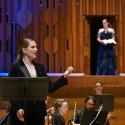
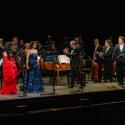
Though only giving the opera in concert, Les Talens Lyriques made rich amends by picturing the action out in the auditorium and by skillfully ringing the changes on the lighting of a splendid old Versailles set as backdrop. And so something of the splendour which must have attended the opening of the Théatre Royal (pictured above) for the wedding of the Dauphin, soon to be the ill-fated Louis XVI, and Marie Antoinette with a performance of Lully's Persée, illuminated all of us. Very well, so I'm of peasant Huguenot stock and something of the revolutionary in me stirred on the earlier tour. But I came out of the royal enclave on the wintriest of Friday nights treading airily on the snow of the huge Versailles courtyard.