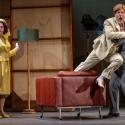
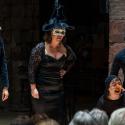
There’s a lovely moment in The Opera Group’s production of Bow Down. An actor motions to a member of the audience and grins bleakly: “He thought he was here for an opera….”. It’s an aside, over before we’ve even fully registered it, but it’s one that reminds us that both Tony Harrison and Harrison Birtwistle knew exactly what they were doing when they constructed this amputated, bleeding limb of a work and christened it an “opera”, back in 1977.
It would be hard to imagine two more brusque, pitilessly beautiful artists than Birtwistle and Harrison. From Lancashire and Yorkshire respectively, each cuts niceties back to the bone in the astringency of their work, raging fiercely and often inscrutably in a world of tame cultural apologists. There’s also a shared allegiance to art’s instinctive urge to storytelling, and it’s this that comes to the fore in their ballad opera-in-little-but-name Bow Down.
Slicker episodes for dramatic ensemble are intercut with wilfully simplistic musical gestures
The fruit of Birtwistle’s time at the National Theatre, Bow Down takes the grim little folk tale of the Two Sisters (two sisters, one lover, a murder and then a ritual execution) – a story whose evolutions takes in much of Europe as well as North America – and creates a theatrical collage. The many different narrative variants coexist and interact in a free-form piece that comes at truth by the side entrance.
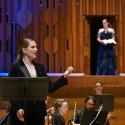
Characters move and are exchanged fluidly among the small cast, who most often speak in chorus, weighting Harrison’s eloquent couplets (only he of V could avoid twee here) with drums, tuned percussion and a partly improvised haze of flute, oboe and recorders.
As the inaugural production for Frederic Wake-Walker as artistic director of The Opera Group it’s an uncompromising choice, partly for its improvised elements, but mostly because there’s so little actual singing involved. Whereas Birtwistle’s “dramatic pastoral” Down by the Greenwood Side marries its folk material to a recognisably contemporary score, here we have to trawl for music among the densely visual wreckage of legend and narrative, sharp with contradictions and dead ends.
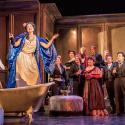
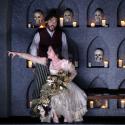
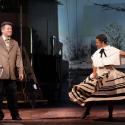
 Wake-Walker’s young cast (named but uncredited on the cast list, owing to the free exchange of roles) help to emphasise the naïf quality of the work, with slicker episodes for dramatic ensemble intercut with oddly simplistic musical gestures. It’s a precarious structure that topples at the slightest imbalance, and occasional moments of faltering pace or energy do punctuate the show’s hour. These are balanced by the work of the male actors, whose revisionist, male iteration of the tale (complete with vividly enacted ejaculation joke, some casual necrophilia and plenty of vintage Harrison filth) offers a welcome moment of levity.
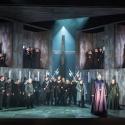
Framed in the cavernous, unfinished space of Shoreditch’s Village Underground some of the finer textual details are lost, as are both much of Anna Jones’ minimal designs and Wake-Walker’s foreground dramatic gesture if you sit anywhere but the front rows. Perhaps guessing at the missing element, improvising mentally to fill in the gaps, is the final stage in the evolution of the legend, but it’s not ideal.
“Find the beef, the beer, the bread, then look behind”, urges Harrison elsewhere in his poetry. It’s an injunction Bow Down takes to heart, examining the physical traces and everyday remnants of a story – fossilised into legend – and unpacking the cultural processes behind them. It’s clever, bold, and in 2012 now feeling just a little bit dated. Perhaps it’s the earnestness of performance, perhaps it’s the work’s rusting mechanisms themselves, but for all its brutality Bow Down offers an oddly bloodless experience.