If you read the synopsis of Candide - which I strongly advise if you plan a visit to this new WNO production - you may well wonder how it will be possible to get through so much in so short a time. Voltaire’s novella is itself fairly short, but opera takes more time and songs are songs, not action.
It can’t be said that everything in James Bonas’s staging of Leonard Bernstein’s operetta is ideally clear; but somehow it manages to chart the eponymous hero’s progress from his Westphalian birthplace, via Lisbon at the time of the 1755 earthquake, Spain of the Inquisition, Montevideo, Eldorado, and eventually Constantinople, where he and his beloved Cunégonde finally achieve the simple, happy life they have sought, with devastating lack of success, in the light of Dr. Pangloss’s philosophy that “all is for the best in the best of all possible worlds.”
Clarity is aided by the use of a spoken narration (presumably as in the 1989 Scottish Opera version of this much-rewritten score), amplified like all the voices; but chiefly by the vivid precision of the staging, and especially by the incomparable brilliance of Grégoire Pont’s animations, projected on to a front gauze curtain, and irresistibly clever and witty in their cartoon-like portrayal of movement, travel, scene change, or simple environmental catastrophe. In combination with Thibault Vancraenenbroeck’s spectacularly colourful sets and Nathalie Pallandre’s endlessly inventive costume designs, the production’s visual aspect is worth the price of the ticket on its own.
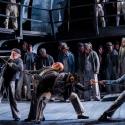
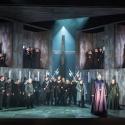
 The music also has its moments, nice tunes in a variety of idioms, brightly scored (not always by Bernstein), and with pungent hyper-doggerel texts by a whole roll-call of Broadway writers, bussed in at various times after the abandonment of Lillian Hellman’s anti-McCarthyite original. But somehow it never quite measures up to expectations that might be aroused by West Side Story, which after all was composed at exactly the same time. To all intents and purposes this is just another musical, with the familiar Broadway/Hollywood tendency to drown its message in increasing waves of sentiment and pizzazz. By the time the company lines up for the final chorus in praise of the simple life, Voltaire’s irony has long ago gone the way of Candide’s uncle’s Westphalian castle (main picture).
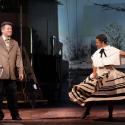
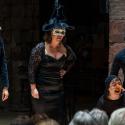
It would be hard, though, to imagine a more persuasive performance, tellingly MC’d by Gillian Bevan as the narrator, reading, as it were, from an old copy of Voltaire, then popping up effortlessly as Pangloss him- or herself (gender-swapping being a predictable side issue of the production). Ed Lyon gets Candide’s agreeable naivety to a tee, smiling sweetly as he commits a series of supposedly unintentional murders, and Claudia Boyle sparkles eloquently (and stratospherically) as the much-ravished, twice dead Cunégonde (pictured below).
 Of the rest of a big, consistently excellent cast and chorus, Madeleine Shaw’s single-buttocked Old Lady, Francesca Saracino’s easy-virtued Paquette, and Aled Hall’s predatory Mexican Governor are outstanding. Ewan Jones choreographs the kind of stylish dance that helps ensure a sense of narrative movement and line, and Karen Kamensek conducts the WNO orchestra, located for some not wholly clear reason upstage, with bounce, energy and immaculate timing.