Are "Cav and Pag" inseparable? Clearly not, to judge from Opera North's "Little Greats" and elsewhere, but it's still the pairing of choice. Tricky, because as music-theatre, Leoncavallo's drama of rough life entwined with rough art stands high above Mascagni's Sicilian village shenanigans, despite great scenes and numbers in both. Director Damiano Michieletto, with his more than superficial connections between the two, has already been praised for solving some of the disparities (not least the fact that Cavalleria Rusticana takes a good quarter of an hour to get started). In this Royal Opera revival tenor Bryan Hymel, bravely taking on both the rustic lad and the violent trouper for three performances, initiates different problems by offering no notable dramatic or vocal differences between the two tenor roles.
The voice certainly stays the course. Not quite the necessary dash of Italian sunshine there, and a bit of bottling up top; but the sobs around the notes are authentic enough. But these are samey brutes, not helped by Michieletto's insistence on physically violent characterisations, as far as they go, which make Turiddu's too-late concern for his discarded Santuzza seem implausible and insanely jealous Canio's declaration that he loves his wife a mockery. Hymel sings Pagliacci's hit number, "Vesti la giubba" ("On with the motley") with intensity, but it doesn't come from a deep place, and he sticks with the stock laughter before the aria and the sobs after the last phrase. A tougher director than Rodula Gaitanou, responsible for this revival, would have insisted on cutting all that out.
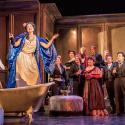
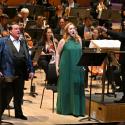
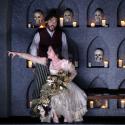
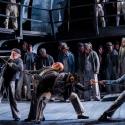
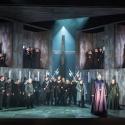
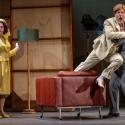
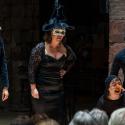
Both operas inhabit dark places in Paolo Fantin's sets. Strip lighting in the bakery stays on against a sombre background throughout Cav, despite the chorus singing of orange-blossom and larks; no summer evening light breaks through the school hall where the action of this Pag takes place, making it difficult for Nedda to "see" the birds whose freedom she envies. Carmen Giannattasio (pictured above with Simon Keenlyside as Tonio and Hymel as Canio) returns as a flinty strolling player, complete with a nuanced young village lover in 23-year old Andrzej Filończyk's Silvio, but it's Elīna Garanča as Santuzza who gives the most fully rounded performance. Her mezzo lustre never struggles with the high flares of what has always seemed more a soprano part (like Carmen, a role in which Garanča also excels, uniquely in my experience). Michieletto sets her up as the village outcast, as prone to visions – a judgmental statue of the Virgin – as Canio is in seeing lovers everywhere, with the director taking his most daring gambit in moving the play-within-a-play off the tiny village stage and into Canio's mind.
There are solid, one-dimensional performances (is more required?) from Mark S Doss as mafia boss – originally carter – Alfio in the Mascagni and Simon Keenlyside as a loud, burnished Tonio whose gestures don't quite add up and who, as originally intended, gets the final line - "la commedia è finita!" - after Leoncavallo's bloodbath (unfortunately the spotlight didn't fall on him on opening night) .Elena Zilio is required to do a lot of rather stagy acting as Turiddu's mother, undermined by being made up as more of a nonna than a mamma, Sicilian village life's ageing propensity notwithstanding. Choruses young and old relish their lively turns, but there's a touch too much restraint here and elsewhere from the conducting of Daniel Oren. Some set pieces for the strings are consciously urged; too much else is underfired, fatally so in the closing stages of Pagliacci. It's an engaging evening, but never a hair-raising one.