The obstacles that have faced Noah Max in the five years since he resolved to make an opera of John Boyne’s Holocaust novel The Boy in the Striped Pyjamas would have stymied someone less determined. Not just the usual fundraising and logistical challenges that every opera has to deal with, but also Covid – and the demand from the story’s rights holder for £1 million for their permission.
This was amended down to a manageable amount after the public involvement of, among others, the Jewish Chronicle, and so the project has finally reached fruition in a sold out two night run at the Cockpit Theatre in London, and it is to Max’s credit that he has made it happen, more or less through the force of his will.
He is clearly talented as a publicist as well as musician, as witness his appearances on Radio 4’s Today and in the Sunday Times this week. Both of these focused on some of the ethical issues involved in making a work of art about the Holocaust – an argument I don’t intend to insert myself into, as I haven’t read the book and don’t feel informed enough about the debate in general. Max, though, has the credentials to take on the task: Jewish himself, he lost family in the Holocaust and is only here today because a forbear escaped Vienna in the nick of time. He has approached the task with thoughtfulness and seriousness of purpose, and made artistic decisions to tie the story into his Jewish heritage, such as the intonation of Hebrew prayers used as a recurring device throughout the piece.
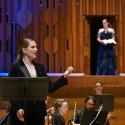
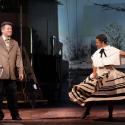
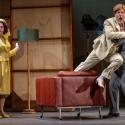
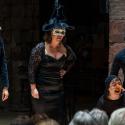
 In A Child in Striped Pyjamas he casts adult women singers in the parts of the two nine-year-old boys, who form an unlikely (and, to critics, downright impossible) friendship across the divide of Auschwitz: one Jewish and the other the son of the camp commandant. This is a good decision: the two central performances were excellent. Rachel Roper as the Jewish child was vocally compelling and clear, with a defiant strength. Susanna MacRae as the German child had the morning challenging lines, often quite disjunct and very high. She handled them well, although there was a slight lack of firepower in the upper register.
The other two cast members were Jeremy Huw Williams as the Commandant (pictured below by Bonnie Britain), and Xavier Hetherington as Lieutenant Kotler. Williams is a vastly experienced operatic performer – a real casting coup for the production – and brought a humanity to the father, especially in the final scene after the children’s death. He was able to turn on a sixpence between savage cruelty and parental concern. But thereby hangs a potential controversy: does humanising the Nazi enrich the storytelling, or undercut the horror of the camps? The violence of the storyline is reflected in the music, which, apart from some oases of quiet consonance, is largely made up of hyperactive, jagged lines and harmonies. It is expressionist in its intensity, and certainly doesn’t beautify the subject matter. Scored for an ensemble of six players, Max shows a high degree of textural inventiveness to sustain 75 minutes of music, but lacks the weight of sound to really punch through at the climax of each act. This is of course a facet of the practical restrictions at play, but perhaps even the inclusion of one more player – a percussionist, say – might have made all the difference? That said, it is marvellously scored and the players were admirable. Lovely moments included the wind players blowing through their instruments to create a ghostly timbre to accompany the gas chamber scene. Max himself conducted the performance with clarity and complete commitment, even joining in vocalising the prayers at the end.
The pared-down production, directed by Guido Martin-Brandis, sensibly kept out of the way of the music but maintained momentum in the long dialogues between the two children. I felt the dining scene got stuck between literal presentation and the fable element that was implicit. As for the piece, it is a remarkable achievement for a young composer. Max developed the libretto himself, often a red flag, but he avoided lots of the pitfalls self-libretting composers often fall into. The text was clear and, crucially, not too wordy, but also no more than functional, and I was left wondering whether having a writer, another creative imagination, involved could have added a level of poetry? Maybe that is something Max was specifically seeking to avoid, which I can understand – but with opera there is always the question “why is this being sung rather than spoken?” and I wasn’t always sure this opera answered that question. The vocal lines compensated for the plainness of the text in their athleticism and colour, although at times felt perhaps a touch overwritten, over-elaborated.
Hats off to Max for seeing this project through from beginning to end, showing great entrepreneurial skill, unswerving drive, as well as compositional craft. I am sure it will go on to have other productions and he is in the first stages of a notable career