Cosi fan tutte is, as the opera’s subtitle clearly tells us, “A School for Lovers”. But too often these days it can feel like a school for the audience. Joyless productions lecture us sternly on the battle of the sexes – on chauvinism, feminism, cynicism and sex – until we’re battered into fashionable discomfort. A happy ending? For Mozart’s most complicated comedy? Don’t be naïve.
Director Laura Attridge has bucked the trend in her new staging for English Touring Opera, and it’s bliss. Against the odds we find ourselves in a colourful screwball-comedy – a sunny, funny musical game of kiss-chase that’s all canoodling behind the potted palms, suave linen suits and silly moustaches.
It’s all terribly decorative and genuinely funny
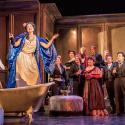
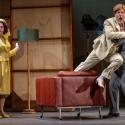
Relocating Mozart’s partner-swapping action from 18th-century Naples to 1930’s Alexandria gives Attridge an exotic, expat playground to work with. Her two heroines pass their time playing beach games in candy-coloured outfits and draping themselves elegantly over chaises longues in cool, tiled interiors, while English-writer-abroad Don Alfonso lingers at café tables, notebook in hand, manipulating his living cast of characters for his latest work.
It’s all terribly decorative and – thanks to a decision to stage the work in English, in a wonderfully witty and slick translation by Jeremy Sams, dispatched with exemplary clarity by the young cast – genuinely funny. Judicious cuts (and plenty of them) keep the action bowling along, pushing pleasingly swiftly through the more slapstick intrigues. The often wiltingly protracted Dr Mesmer episode is dispatched in just a few uproarious minutes.
Minute attention to physical comedy (careful synchronisation of movement to music, playful choreography and plenty of broad sight-gags) gives a real verve to a performance that often feels closer to musical theatre than opera. There’s a lightness, a freshness, an ease to it all visually that isn’t quite, as yet, matched musically. The giddy energy that drives the drama so effectively seems to unsettle the music, with singers too often pulling away from the band and tempi refusing to lock into place.
 The problem is less conductor Holly Mathieson’s clear, unshowy choices than period ensemble the Old Street Band, whose lack of body and bass oomph leave the singers without their musical anchor. ETO is a lean operation whose other productions this season (Handel’s Giulio Cesare and Bach’s St John Passion) demand period instruments, so the choice is less artistic than pragmatic. Unfortunately that does show.
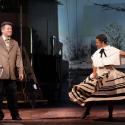
Singing is small-scale, balanced to the lightweight band, and seems likely to improve as the run continues. On opening night things were still finding their feet musically for Joanna Marie Skillett’s conflicted Fiordiligi. “Per pieta” not “Come scoglio” was the key to a soft-hearted heroine, whose slide from stern virtue into shy passion was beautifully handled. There was broad comedy and big emotions from Thomas Elwin’s Ferrando and Martha Jones’s Dorabella, but it was Frederick Long’s strutting, Flashheart-style Guglielmo (pictured above with Elwin) who dominated – natural comic timing paired with a lovely open, unforced tone making him the boy we all love to hate.
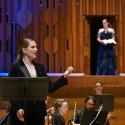
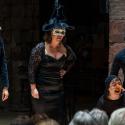
 Comic support came in buckets from Jenny Stafford’s game Despina and Stephan Loges’ lean-back Alfonso (pictured above), whose languid ennui and understated delivery offered a still point among so many goings-on.
Watching the show, it’s hard not to make comparisons to recent offerings at English National Opera. This Cosi is precisely what we should be getting from the larger outfit: crisp, playful, joyful, unfussy musical theatre. Prioritising text and drama while eschewing gimmicky concepts, Attridge and ETO let the opera sing. I don’t know when I’ve enjoyed a Cosi more.