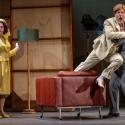
Of the two works by Hans Werner Henze on this curious if ultimately satisfying double-bill, neither quite answers to the name of opera. Henze originally conceived The Country Doctor as a radio opera, that still-rare and unfairly maligned genre, which allowed him to set the whole text as Kafka wrote it, with the doctor a disembodied voice at front and centre, a neutral observer of his own mental disintegration while the imagined events of his long dark night of the soul work their horror around him. The stage adaptation Henze wrought in 1964 was really a vehicle for the gifts of Dietrich Fischer-Dieskau, which perhaps he came to acknowledge three decades later by making one final revision that gives the subsidiary characters their own voices back.
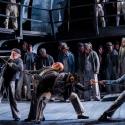
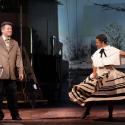
If Martin Hässler was intimidated by the shoes he was filling or the scale of the challenge, he never showed it. With restrained, naturalistic movement around a simple set, he misplaced not a word of a part that continually shifts from recitative to Sprechstimme to arioso and back again. The simple set by Claudia Chisholm places the doctor in his own study but moves Kafka to the centre of the action by projecting the text onto the back wall: the doctor may have eventually made it home – if he ever left – rather than being lost amid the snow, but his mind is forever wandering a Winterreise landscape between nightmare, madness and the grim reality of a life accepted with the fatalism of the boy whose death he is powerless to prevent.
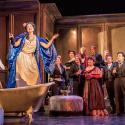
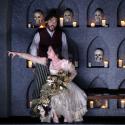
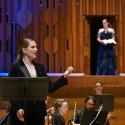
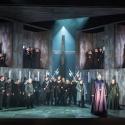
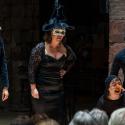
To Phaedra Henze gives his most testing coloratura, and Mainwaring sails through it without chewing the sceneryWho is telling the tale, and at what distance? How reliable are they? Henze often returned to such narrative ambiguity, though mostly with sardonic enjoyment of an audience’s discomfiture, as in tragi-comic denouements of The Young Lord and The English Cat. Phaedra moves from an alienated retelling of the Euripidean legend into quasi-mystical contemplation that may have prompted the billing of "concert opera": interrupted by a serious health scare, it was to be his final dramatic work. The libretto (fashioned in high-literary style by Christian Lehnert, and sympathetically translated in the surtitles) moves freely across time and space, and so does Ashley Dean’s staging. The gods who take sides for Phaedra and her stepson Hippolytus are humanised to create complex, four-handed interactions and undermine the stereotype of us as Lear’s "wanton flies".
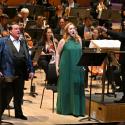
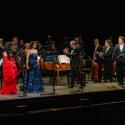
Over more than half a century, Henze’s own style evolved from the dodecaphonic patter of The Country Doctor to a dense synthesis in Phaedra of Italianate vocal writing and unrelenting post-expressionist harmony lifted here and there by memories of himself in neoclassically Stravinskian humour. Even the scoring for a 23-piece band doesn’t bridge the gap between the styles, though Timothy Redmond’s conducting was discreetly effective and nurtured some delicate playing from the pit-band. In every respect the production values offered more than might be expected of even specialised, accomplished students. The countertenor of Meili Li (as Artemis, protector/tress of Hippolytus) is as yet small but well-formed, and Rick Zwart’s brief solo as the Minotaur revealed a baritone hardly less even and ingratiating than Hässler’s (the two singers swop roles later in the run).
Lawrence Thackeray nicely captured the paradox of Hippolytus as a powerful victim, though he didn’t sound at ease with some of Henze’s more heroic tenor gestures, and the final image of him, lost and weak, somewhere between life and death, sensitively brought Henze himself into the drama. Laura Ruhi-Vidal was a winningly capricious Aphrodite, but the most eye- and ear-catching stage presence was Ailsa Mainwaring in the central role, alternately scornful and rejected, a woman like Kundry who hardly understands her own power (not the only Parsifalian allusion in either the piece or the production, thanks to the ingenious magic garden of Dan Shorten’s video designs). To Phaedra Henze gives his most testing coloratura, and Mainwaring sailed through it without chewing the scenery in a performance that comes to grips with Henze’s Verdian heritage.
- Performances run until 15 June