On an Edinburgh afternoon of torrential rain close to the winter solstice, what ecstasy to be transported to an ancient Greek midsummer day, a Claude landscape with shepherds calling across the hills, painted in the most translucent colours by Richard Strauss in his late mastery. All it needs are world-class voices and an orchestra that glows; it got both in Scottish Opera’s concert staging.
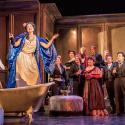
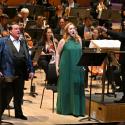
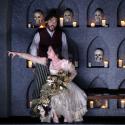
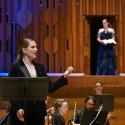
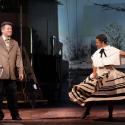
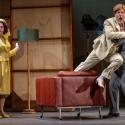
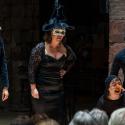
From photos taken at earlier performances in Glasgow and the Lammermuir Festival back in September, the worry was that director Emma Jenkins’ thoughts would tend too much to the troubled 1930s in which Strauss, with his knack of detaching himself from dire circumstances, composed this mythic one-acter. Daphne, the chaste nymph who is turned into a laurel fleeing the advances of sun-god Apollo, is suggested as Sophie Scholl, and the famous symbol of the peace-oriented White Rose resistance movement becomes central, Apollo is an overweening officer in a leather coat and the rest are still celebrating in the style of the Weimar Republic (Hye-Youn Lee's Daphne pictured below).  Too removed from the pastoral idyll and the Dionysiac revels of rural folk? Fortunately not. Strauss’s hypercharged god with his proto-Hollywood fanfare theme perhaps the only banal element in the score can take the arrogant Nazi overtones. His physical energy was impressively underlined by Australian Brad Cooper (pictured below with Claire Barnett-Jones's Gaea), a very welcome arrival on the Wagner/Strauss scene with strong acting presence and a still-gleaming tone. There are a few misalliances with the text – supertitles rendered Josef Gregor’s poetic-enough mythic rendering better than I remembered – and the divinity might be called into question, but not otherwise the essence of a proud Apollonian figure overwhelmed by Dionysiac desire.
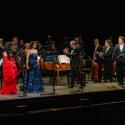
Cooper needed all the strength he could muster because, at least from where we were sitting towards the side of the grand circle, voices were often swamped by the glorious orchestra, and at no point did Stuart Stratford signal to keep the players down. His conducting wasn’t exciting to watch – mostly beating, apparently – but the results were irreproachably handsome, from the bucolic woodwind of the Prelude beautifully led by oboist Amy Turner, the multi-divided strings in Daphne’s first nature-raptures to the opulent brass linings for the lower voices. Strauss, as the programme helpfully suggested, has a careful exposition where he presents each of the main characters; both Claire Barnett-Jones as Daphne’s contralto (earth) mother Gaea and Dingle Yandell as bass water-god father Peneios made impressive impacts, Yandell outstandingly so. There were no weak links among the other voices, many with long-term connection to Scottish Opera, from the select, eight-strong male chorus of "shepherds" embracing solos to the two top-hatted “maids” who encourage Leukippos to drag up for the Dionysiac rites so he can get closer to Daphne (Catriona Hewitson and Inna Husieva, both glowing).
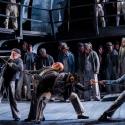
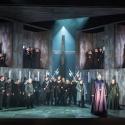
At first the roles of the eponymous nymph and her childhood playmate, fluting shepherd Leukippos, seem to call for lighter lyric voices, but Strauss asks much more of them towards the denouement. Here tenor Shengzi Ren offered full-pelt resistance to the strutting sun-god. Hye-Youn Lee, too, had resources to draw upon way beyond the usual light lyric. The voice is fast-vibratoed, but so was Lucia Popp’s, and there were reminders of that greatest exponent of the role (first stop for anyone who wants to get to know the score in its full beauty must be Popp’s recording with Haitink conducting). As the music goes into full recap drive, Daphne’s lament over the dead Leukippos found Lee pulling out all the expressive stops Lee with Ren and "Shepherds" pictured below)..  As for the epilogue, surely Strauss’s most moving, where Daphne finds herself rooted to the spot and welcomes her transformation into a laurel tree, sound and vision came together beautifully. Jenkins’ restrained staging has the “shepherds” return with white roses, each one of which Daphne caresses in turn before taking a single rose as the rest are laid on Leukippos’ body. With a penitent Apollo and a happy end, the sad reality of Scholl’s execution is transcended, her achievement immortalised, leaving us walking on air. Surely there's more of a future for this ambivalent hymn to nature in the present climate – but productions won't come cheap, given the orchestral and vocal demands. Nothing but the very best will do, and Scottish Opera can be proud of itself on that front.