Lagoon, miasma and scirocco may seem as far away as you can get from the rolling hills and pleasant airs of the Wormsley Estate in deepest home counties territory. Nor are the bleached bones of Britten’s bleak if ultimately transformative operatic swansong the usual culinary fare many punters might have expected to go with their fine wines and gourmet picnics. Against the odds director Paul Curran makes it all work, going about as deep, disturbing and ambiguous as the work allows while still serving a star performance in Paul Nilon’s Aschenbach and adding to the opera-ballet dimension that Britten originally envisaged in his tricky homage to Mann; at times you might have thought we were back in Rameau’s magical weave of dance and song.
Stripped of most Venetian trimmings other than the billowing curtains of the Grand Hotel des Bains, lending their constant presence here as the chimerical barriers that cut off the protagonist from the real and unattainable worlds, and a distant view of Venice proper from the water, all focus is on the total isolation of Mann’s closeted writer with creative block and a desperate need for emancipation.
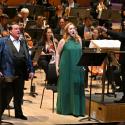
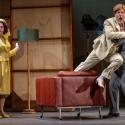
 What a remarkable opera this is when there’s no sung relationship of any meaningfulness, and none at all, as the Aschenbach of Myfanwy Piper’s risky libretto puts it, which is not one-sided. For a performance as heroic as Nilon’s (pictured right with William Dazeley as the Old Gondolier), my memory reaches back not as far as Peter Pears in distinguished later years, but to the beautiful phrasing of Anthony Rolfe Johnson and the searing intensity of Philip Langridge (both no longer with us, enriching and saddening the meditation on death). Nilon, whose Opera North performance as the dream-haunted hero of Martinů's Julietta left me longing to see him do much more in the Langridge line, combines both, but with a unique plangency. The quality is to the tenor world what Frederica von Stade’s uniquely larmoyante or tearful voice was among mezzos. The loneliness is heartbreaking, the disintegration into an abyss of desire terrible.
From the start – a lone clarinet pulsing perhaps the arrhythmia of Britten’s own heart condition, Aschenbach’s mind beating on emptiness to a miraculous tissue touching on all 12 tones of the chromatic scale – you’re drawn into a strange inner world which Curran finds a phantasmagorical edge even in the rather arch genre scenes with their sometimes stilted interjections.
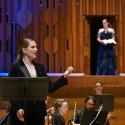
It helps immensely that under the experienced guidance of Steuart Bedford, who conducted the world premiere at Snape Maltings on 16 June 1973, the instrumentalists are all there before us in the wondrously intimate Garsington pavilion as participants in the action. The woodwind, so close and direct, sometimes sound like John Adams’s synthesizer – in a good way – while the timpani cracks out the tattoos of the mysterious stranger manifest as a malign Dionysus to make the audience’s heart miss a beat or two. Cellos and basses scour the soul with flecks of a stunningly present harp (Sue Blair, dazzlingly to the fore); lean upper strings writhe in agony. It all hits home as I've never quite experienced it other than on the Decca recording conducted by Bedford with Pears as Aschenbach.
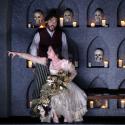
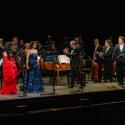
 The orchestral players' counterparts on stage are a flawless ensemble. 26 bright young singers prove equal to the annually legendary Glyndebourne team whether in choral paeans or in the multiple small roles of Venetians and hotel guests. Garsington's programme rightly highlights the promise of baritone Henry Manning, smoothly enunciating the news of cholera’s spread, and of tenor Joshua Owen Mills who makes his clarion mark as the Hotel Porter. There are 10 characterful dancers – two women (Nina Goldman as the Polish Mother, Georgie Rose Connolly as a Governess who reminds us that, yes, there is female desire going on here too), two children and five beautiful and/or sexy young men, dominated of course by the Tadzio of Celestin Boutin (the Games of Apollo pictured above).
It’s always a slight difficulty adding years to Mann’s object of aesthetic admiration and desire (originally a pre-teenager, definitely on dodgy territory as indeed of course was Britten himself) to suit the musculature of an accomplished dancer. But Boutin passes muster better than any Tadzio I’ve seen, and as Curran clearly wishes, Andreas Heise’s choreography also ups the dance sequences to places where Britten wouldn’t necessarly have expected them, giving Tadzio a less passive role than usual. In seeing his adolescent yearnings, confusions and violence unfold, we’re reminded of Miles in The Turn of the Screw, confused by one side (governess and housekeeper) wanting him to be too innocent, the other (the ghosts) too depraved. Aschenbach’s part in all this, embracing elements of both, is ambiguous, but it does yield some astonishing scenes, not least the not-quite Pas de Deux before the broken declamation “I love you” at the end of Act One. Its desperately sad sequel, an alternative to the usual deckchair-slumping and beckoning spirit, plays out to the final transfiguration where Britten succeeds in offering his own uniquely spare version of Mahler's last three symphonic epilogues.
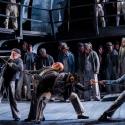
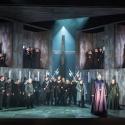
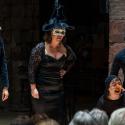
 Not all the music is quite on that level; the fatally ill composer, though composing the most frank operatic confessional of his life, was struggling, and might have made changes had he lived longer, not least to the rather bleached Games of Apollo. Heretically, I’d cut them, but I guess the Greek ideal needs a place here to counterbalance the much more masterly setting of Plato's dialogue between Socrates and Phaedrus towards the end. Though Tom Verney’s Apollo isn’t the most liquid of gods, the divertissement passes quickly, with the chorus reminding us of death’s presence as gilt-masked, black hooded Venetian carnival ghosts while the games go on among the boys. The jury’s still out on Piper’s exteriorizing, first-person translation of Mann revealing his protagonist’s inner workings; the best one can say of the monologues is that Nilon smooths over the well-intentioned embarrassments with his worried face and ever-present anxiety.
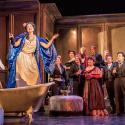
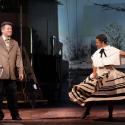
William Dazeley’s handsomely-phrasing baritone has a dark colour right for the harbinger of death if not quite the low notes for, say, the Old Gondolier – this is a bass-baritone role written for the superlative John Shirley-Quirk - and he brings the right sinister quality to the falsettos of the creepy fop, hotel barber and leader of the travelling players. Curran adds the right dimension of Felliniesque outlandishness there (pictured above with Dazeley centre: definitely not the "Honey Bun" sequence from South Pacific), while observing all the symmetries between the acts, and he even makes the Dionysiac dream-orgy work, just. The blues of Kevin Knight’s skyscape always haunt, and Bruno Poet’s consummate lighting knows how to bleach them when disease, disorder and death beckon. And oh, that final not-quite consummation. If it works for you as it did for me, you won’t want any more Garsington badinage afterwards; best sit in the peony-rich formal garden for half an hour in meditative silence before the journey home.