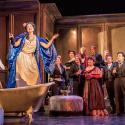
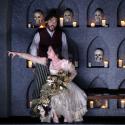
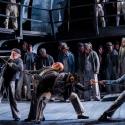
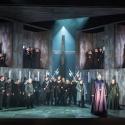
Like the Dutchman himself, Tim Albery’s Der fliegende Holländer makes its inevitable return to the Royal Opera House. Unlike the Dutchman, however, this production has broken free of its cycle of repetition. Perhaps expectations have changed, perhaps after two outings I’ve just surrendered to Tim Albery’s severe and sober staging, but for the first time since its 2009 debut this ghostly ship finally comes in to emotional harbour.
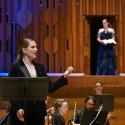
This unexpected sea-change has everything to do with Canadian soprano Adrianne Pieczonka – a blisteringly beautiful Senta, who pairs a disarming purity and sweetness of tone with tremendous vocal power. There’s a ferocity, an intention to her delivery that makes sense of Albery’s rather oblique production. Here is a woman possessed by an unnatural obsession, a woman set apart from the grey world around her by the blazing belief in her destiny. The candle she carries throughout her ballad mirrors the searchlight that strafes the audience throughout the overture, a beacon leading her to her only possible fate.
Where Anja Kampe has previously showed her vocal working in this role, Pieczonka gives little sign of strain, discovering new power and heft for a final scene that chills with its conviction. This Senta might not throw herself into the water at the end, but for the first time that doesn’t seem to matter. As she drops to the floor, clutching the miniature ship to her belly, we know that this curse, this death, is one of the mind, just as her passions were too.
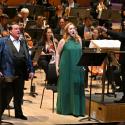
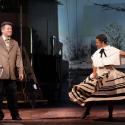
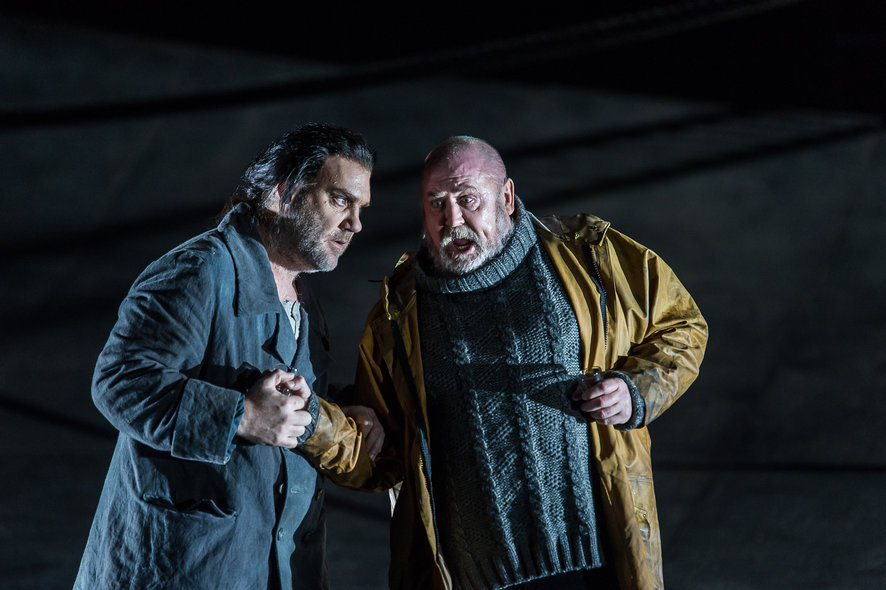 Bryn Terfel (pictured right with Peter Rose as Daland), the production’s original Dutchman, returns here – wiser, possibly, and certainly more bitter. If there’s less vocal loveliness here than once there was that’s no bad thing, with the character crystallising into something altogether crueller and more inscrutable. The odd crack on opening night only added to an unselfconscious performance that eschews any kind of show for a psychological seriousness. “Die frist ist um” feels more contained, the arc of emotion starting smaller but more potent, aided by David Finn’s claustrophobic lighting.
Michael König leads the best supporting cast yet for this production, crooning out his pleas to Pieczonka’s Senta with dangerously persuasive delicacy. With two voices blending power and beauty so equally,“Bleib, Senta! Bleib nur einen Augenblick!” was transformed, matching the orchestra’s strings for blend. Also impressive is Ed Lyon. Currently reprising his Amidas over at the Globe in L’Ormindo, the tenor is living something of a double musical life at the Royal Opera this month. If Tuesday night’s Cavalli showed his musicality and way with an ornament, last night’s Steersman was all about power and projection. This is a voice that just keeps growing, and though it lacks John Tessier’s legato in this role, it finds a ringing brilliance that is all its own.
Andris Nelsons conducts a performance that is both gentler and more sensitive than his recent recording with the Royal Concertgebouw Orchestra. Wind and brass had their scruffy moments (as did the chorus, though also moments of glory), but the overall momentum was steady and controlled – a match for Albery’s unfussy visuals.
Far from weather-beaten, this Dutchman is improving with age and acquaintance. A clean visual concept and stellar singing remind us of what this house does best – a merciful contrast to the 2014’s last adventure on the high seas. There’s not a shark in sight, but Der fliegende Holländer still has more menace in its watery pools than Idomeneo in its ocean.
- Der Fliegende Hollander at the Royal Opera House until 24 February