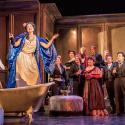
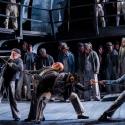
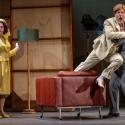
Der Rosenkavalier, you might think, is one of those operas that belong in a specific place and time and no other. “In Vienna,” says Strauss's score, “in the first years of Maria Theresia’s reign” (i.e. the 1740s). But this, of course, is a provocation. For the Welsh National Opera, Olivia Fuchs updates it to, roughly, the date of composition (1910-11), or perhaps even a few years later, to judge from the flickering gunfire, and the heavy emphasis on militarism in the programme. And she supplies the Marschallin with a Doppelgänger in the person of an old lady dressed 1930s/40s, who haunts the stage whenever the Marschallin (aged 32) moans about her age, which is a good deal of the time.
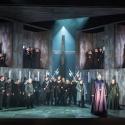
Fuchs is a fine stage director and a good stylist. Apart from some anachronisms in the text and a few vulgarities in what publicists would call the sex scenes (Act 1), her version works pretty well. The same plain, panelled set (designer Niki Turner) does well enough for the Marschallin’s bedroom, marginally less well, repainted, for the parvenu Faninal’s palace. The honey trap in the inn springs brilliantly, with noisy, bouncy children, flashing lights, etc.
But oh! these Doppelgängers or alter egos, or whatever they are, cluttering the stage and double-underlining ideas that are already laboured in the libretto. Let’s hope directors grow out of them soon. I imagine them all sitting around together in opera directors’ clubs swapping brilliant new concepts like politicians discussing the abolition of student fees, then going off and all doing exactly the same madly innovative and daring thing with Fidelio (Salzburg), Ulysses (Grange), Tristan (Longborough, but thankfully ditched in the revival), and now Rosenkavalier. Away with it all, I say. Back to the text and then by all means invent on that basis. That’s what the musicians are doing, and in Cardiff they do it marvellously.
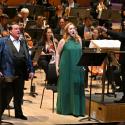
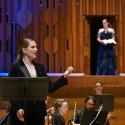
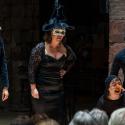
 It would be hard to imagine a stronger cast, vocally at least. Rebecca Evans (pictured right) is short of stature for the Marschallin, but she overcomes this with beautiful, elegant Strauss singing worthy of Schwarzkopf or even Lotte Lehmann. The character herself, though revered by Strauss-lovers, is brittle: strong on manners and protocol but morally bankrupt. We aren’t fooled that her one-night stand with Octavian is anything more than a prelude to the latest disappointment. But Evans is so stately in her dismissal of poor, repulsive Ochs, so dignified in her relinquishing of Octavian, that we almost accept her as a tragic figure whose time has come.
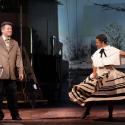
Lucia Cervoni’s Octavian, similarly, is strong on style, with lovely warm colourings in every register and reasonable command of the difficult art of being a girl pretending to be a boy dressed as a girl, though she is not helped by her trouserless state in the first act, exposing the one exposable aspect of the anatomy that, curiously enough, distinguishes the sexes: leg posture. Louise Alder’s Sophie sparkles from the start, in touchingly exaggerated spontaneity at the thought of marriage to never mind who, then vibrant emotion at the real possibility of Octavian. Her singing, effortlessly lyrical, would surely have sent the composer into raptures.
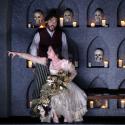
What he would have said about Octavian’s Silver Rose costume – basically a suit of armour – is another matter. But I suppose the Rose-bearer is a kind of soldier, a knight at least, justified in his sword-play with Ochs, and thankfully not, as Fuchs might have made it, gun-play, though the sword is an ornamental one from the mantelpiece, and maybe the armour is as well.
Brindley Sherratt’s Ochs, on the other hand, is not quite the usual scruff, but a decayed squire in check trousers and Loden coat. His rustic patter is fluent-sounding (who ever knows what he actually sings or if he sings all of it?), though not heavily accented, and the voice is a strong bass, with a solid low E at the end of Act 2. Adrian Clarke makes the best of Faninal, a character neither sympathetic nor funny, and with nothing very memorable to sing.
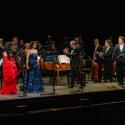
There are other minor upsets: too much waltzing around by the Valzacchis (Madeleine Shaw and Peter Van Hulle, for some reason got up as a clown), a stylish but underpowered Italian tenor (Paul Charles Clarke). But all is overridden by a classic performance by the orchestra under their new, Czech conductor Tomáš Hanus, evidently a master of the movement and big phrasing of late romantic music. I can’t wait to hear him in Khovanshchina and From The House of the Dead. But no Doppelgängers, please.