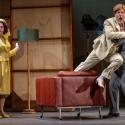
Like Prokofiev’s The Love for Three Oranges and Puccini’s Turandot, Wagner’s first opera – The Fairies in English – has its roots in a “theatrical fable” by the 18th century Venetian playwright Carlo Gozzi. There the resemblances end. Only Prokofiev follows Gozzi’s playful mix of commedia dell’arte and fairy-tale characters. The 20-year-old Wagner has one moment of fun – cut in this performance – but a mere handful of musical gestures and plot devices prophesying greatness to come rises to the surface in this gloopy mess. You’ve got to admire the ambitious scope of it, but inspiration is nowhere to be found.
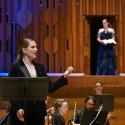
If any conductor can stir the lumps in young Wagner's very thick porridge, it’s the dynamic Dominic Wheeler (pictured below), and if any company can light the dramatic touchpaper in a concert performance, it’s the Chelsea Opera Group, with its bold instinct for casting fine singers and its enthusiastic semi-professional orchestra. Wheeler instantly made the violins rise heroically in their pure-Weber upsurges throughout the overture, with its one hint of things to come in a phrase rhythmically identical to the one in The Flying Dutchman’s Act Two finale.
 That’s it as far as memorable long lines go, but the story and the insane musical demands loaded on its three principals can keep the interest stoked. The convoluted plot essentially involves the vicissitudes of a mortal, Prince Arindal, and a semi-fairy, Ada, his wife of eight years who at the beginning of the opera has vanished when asked the forbidden question about her identity and will turn to stone if he can’t resist the horrors she is forced to inflict on him and curses her for them (he does).
That means the mythic devices look forward not only to Lohengrin but also to Dvořák’s Rusalka, Strauss’s Die Frau ohne Schatten – Andrew Porter’s note tells us Strauss the conductor helped prepare the first performance of Die Feen after Wagner’s death – and Sullivan’s Iolanthe, where the fairies tread much more lightly than Wagner’s booted specimens. You’d have thought that Mendelssohn’s Midsummer Night’s Dream Overture and Mozart’s The Magic Flute, with its three trials anticipating Arindal’s in Act Three, had never happened by 1833.
At least Wagner has delicate woodwind to paint Ada’s otherness, in the manner if not the matter of Brünnhilde’s humiliation in Act Three of Die Walküre. All eyes and ears, though, are on the soprano who has to manage her absurdly long and broken-backed Act Two aria in which she resolves to sacrifice immortality for love.Young New Zealander Kirstin Sharpin rose jaw-droppingly to the challenge.
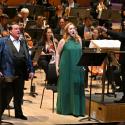
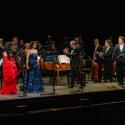
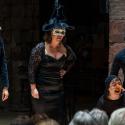
 The luminous warmth enveloping her dramatic-soprano strength will make Sharpin a fabulous Straussian, and she stood in perfect contrast to the steelier glint of Elisabeth Meister (pictured left by Brian Tarr) as Arindal’s warrior sister Lora. Meister was just recovering from a heavy cold, had learnt her part in three weeks and was commuting back and forth from Lucrezia Borgias in Brussels, but you could still hear that this is an ideal Brünnhilde in the making.
With Meister’s arrival in Act Two came a raising of the stakes for both the sometimes unruly chorus - sopranos holding it all together - and the orchestra. It was the start of serious vocal challenges for the likeable tenor hero, Dane David Danholt. This is a gleaming, youthful voice, ideal for Mozart’s doughtier protagonists like Tito and Idomeneo, but more mad vocal writing stretched Danholt to the limit, and beyond in Act Three. Still, conviction proved to be all, as it was for a villainess fairy suddenly thrust to the fore as his enemy, resplendent mezzo Emma Carrington as devious Farzana. The happy end, initiated by a brief harp-accompanied prize song for the hero to his now-lapidary love with everything going for it except the musical idea, had everybody smiling. A youthful opera with a young, promising cast: exactly what we need in Wagner’s bicentenary year.