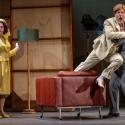
There’s a lot to be said for concert performances of Wagner. Not only are you spared the post-prandial lucubrations of aspirant directors – the moonmen and the fighter pilots, the jackboots and the biogas installations. But it’s possible to concentrate on Wagner’s greatest theatrical gift: not his stagecraft or stage imagery, but his management of time and psychological growth through purely musical means. And the final act of Die Walküre, which the Wales Millennium Centre mounted in a concert performance by Welsh National Opera on Sunday, is the best possible example, with its evolving confrontation between Wotan and Brünnhilde, the daughter he adores but who has defied what she is gradually able to show are his falsified intentions.
Wagner maintained that opera was above all the art of transition, and these 80 minutes or so of unbroken symphonic music demonstrate the point to perfection. From the relentless Hojotohos and Heiahas of the Valkyries in their famous Ride, through Brünnhilde’s desperate flight with the terrified Sieglinde, Wotan’s rage at her betrayal as he sees it, and her gradual wearing down of his fury into a passionate regret and valediction, the emotional trajectory is controlled entirely through musical pacing and the exquisitely timed introduction of new musical ideas.
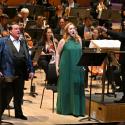
Staging, by contrast, can be an embarrassment: the wretched Valkyries with their (usually invisible) steeds and raucous militarism, Brünnhilde doing her tubby best to look both bellicose and feminine. Sunday’s vestigial production was uncredited, but it had enough of these elements and no more. Bryn Terfel acted Wotan’s changing temper brilliantly through vocal and facial expression; he and the Swedish soprano Iréne Theorin related perfectly through minimal but well-judged movement. Their long dialogue was as moving as I’ve ever experienced it in a staged production, and for the most part as finely sung.
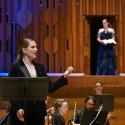
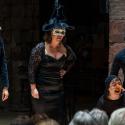
 Terfel is not, to my mind, a true Wagnerian bass. The tone is beautiful but not ideally dark. But he overcomes what he probably doesn’t agree is a problem by sheer musical intelligence, vocal technique and immaculate taste. In this performance there was hardly a note misplaced, even when, occasionally, he played fast and loose with Wagner’s exact pitches. And every vocal nuance had its facial or gestural counterpart, likewise precisely judged. Theorin (pictured above) I found less refined, perhaps less exact in her control, but highly expressive and with a strong, bright sonority. The Sieglinde, Rachel Nicholls, has herself sung Brünnhilde on the small stage at Longborough; but her touching, well projected vignette here suggested that she might handle the larger role on this much bigger platform just as well.
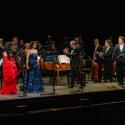
The Valkyries were vocally a superb line-up, visually as well, if not entirely in the best sense: too many to list but without obvious musical weakness. Whoever allowed them to process in during the orchestral introduction got up to the nines and carrying their own music stands, like the streltsy in Khovanshchina bringing in their own execution blocks, should be consigned to Brünnhilde’s mountain-top without parole. One shouldn’t make fun of Wagnerian sopranos: they are too soft a target.
Lothar Koenigs conducted a lucid, beautifully sustained performance. I’ve heard more thrilling sound from this orchestra, but their discipline and integration remained undented by being for once in full view, and I lost count of the fine details and exquisite moments in what is one of Wagner’s most delicately scored acts. This kind of listening is the greatest bonus of concert Wagner. It reminds me of Stravinsky who, when he went to Parsifal in Monte Carlo in 1913, got himself a seat from which he could see nothing and hear everything. Sometimes those are the best seats.