Something is afoot at Garsington this season. Walking past the lake you might just catch sight of three strange figures in the distance – white-clad pawns engaged in a solemn game of human chess. Continue towards the auditorium and, somewhere among the topiary, there’s a splash of colour. A man with the cap and long red robes of an Inquisitor stands silently and contemplates the statuary. Opera, once again it seems, has fallen through the looking glass.
Like so many directors before her, Netia Jones turns her gaze back on itself for the new production of Mozart’s Die Zauberflote that opens Garsington’s 2018 season. There’s something about the ambient, immersive quality of country house opera that seems to inspire this kind of self-referential play, not so much navel- as cummerbund-gazing. Dressed up in our strange costumes, wandering incongruously through the English countryside, we offer ourselves as willing extras in the drama, ready to be co-opted, confronted, coerced into the action. So it’s no surprise to enter the auditorium and find ourselves outside in Wormsley’s own box-edged lawns and gardens, staring at the manor itself. Perched on its façade like so many sinister pigeons are clusters of grey security cameras – just in case we were in any doubt as to where the gaze of this production was pointing. But having got us in her sights, Jones proceeds to baffle, serving up a Magic Flute that seems designed as a modern parable, but whose determined relevance renders Mozart’s most magical, allusive opera curiously literal and inert.
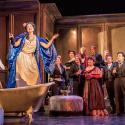
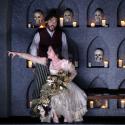
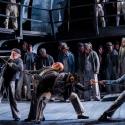
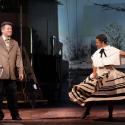
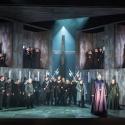
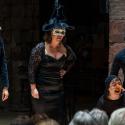
First, the good. Jones has designed one of the handsomest productions we’ve ever seen in this auditorium. Her signature monochromes are off-set by pops of deep red, green and orange, and her subtle video work brings depth and intrigue to a flat set. Costumes that riot between the 16th and 20th centuries, with just a hint of dystopian future thrown in for good measure, offer plenty to delight the eye and plenty of food for the mind to chew on. The Upstairs, Downtairs quality of the country house setting allows Jones to embrace the contradictions and polarities of the piece into a single milieu, revealing tensions and contradiction within rather than between worlds. This is a production that’s good at undercutting, interrogating. Any moment of beauty or sweetness is spiced with doubt. Papageno lovingly skins and guts a rabbit during his charming first aria; Monostatos and his men dance, compelled not by the twinkling magic bells but by the strafing barrel of a shotgun. Here is beauty and order, certainly, but facilitated by the grubby below-stairs labours of meat-cleaver-wielding Monostatos and his fellow workers – the silent army of bonnet-clad women, refugees from The Handmaid’s Tale – without whose invisible labour the brotherhood could not free their minds so effectively to contemplate higher things
It may all be true and topical, but the trouble is it’s not terribly interesting – a story about superstition and enlightenment rationalism is transposed to patriarchal privilege and female emancipation. The joy of Mozart’s strange creature of a final opera is its anarchic, elusive quality – allegory more as a mode than as a fixed set of meaning. Jones may have succeeded in subduing the piece’s more stubborn difficulties, but it’s at the expense of the life of the work, pinned fatally in place like a lepidopterist’s specimen.
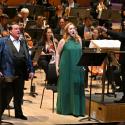
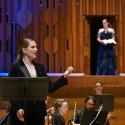
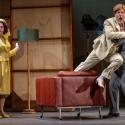
 Which is a shame because this is as strong a cast as Garsington has ever fielded. Soprano Louise Alder (currently alternating Garsington’s Flute with performances of Der Rosenkavalier at Glyndebourne: pictured right, with James Creswell's Sarastro) brings just enough grit to the gloss of Mozart’s least interesting heroine. Her Pamina is sceptical, assertive – a bold figure in slacks among all the aprons and bonnets – who scoffs at a prince who could fall in love with a girl he has never met. She finds her match in Benjamin Hulett’s Tamino. Heroic of voice and presence (no crooning for his “Dies Bildnis”), he’s no fey princeling – a match if ever there was one for James Creswell’s luxurious Sarastro.
But if Jones and conductor Christian Curnyn discussed their various approaches there’s little evidence of it here in the music. Taking away every phrase-ending, lightening and quickening every texture and tempo, finding the dance under every aria, Curnyn conducts a delightful Handel comedy, while on stage Jones gives us a Mozart near-tragedy. Only Creswell has the force of musical personality to carve the beauty, space and depth out of this glorious score, giving us pause among so much brittleness. Jonathan McGovern sings a lovely Papageno, but with the role shorn of all comedy (save a blissful final scene with Lara Marie Muller’s delicious Papagena) he’s given little to work with.
An awkward ending (no spoilers here) offers a problematic resolution to Jones’s Gender Studies seminar of a production. I hope she’s taking questions, because I suspect mine will not be the only hand raised.
- Die Zauberflöte at Garsington Opera to July 21
- Read more opera reviews on theartsdesk