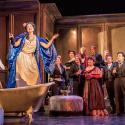
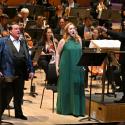
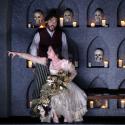
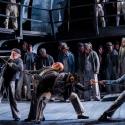
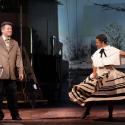
What happens on the stage of Stockhausen’s first opera would fill a book – quite a bad novel – but the plot is simple enough. Michael grows up with a domineering, game-hunting father and mentally unstable mother; discovers sex; passes his exams; travels the globe and finds his calling in life as a visionary and saviour.
Premiered in 1981 and last seen in London in 1985, this skimpily veiled autobiography launched a cycle of seven music dramas, one for every day of the week and each of them reinventing from scratch what we think of as opera. The brassy Greeting in the foyer of the Royal Festival Hall, and Farewell played from its balcony over the Thames, serve not only to fix the musical themes in the minds of audience members, but also to shut down discussion between them. The opera’s concluding scene – a half-hour Vision – explains what has been seen and heard at painful length. There is no room for argument: this is the world according to Stockhausen.
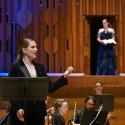
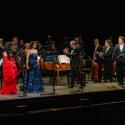
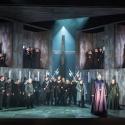
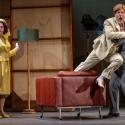
It’s a disorienting experience to be taken inside and shown around the mind of a creator with at once brazen confidence in his own genius and yet squeamish insecurity about whether you’ll understand or like what you find there. At the climax of Donnerstag’s penultimate and richest scene, Michael fights off and then shames his nemesis Lucifer, who delivers a tirade against humanity and wanders away with baleful shouts of “Naïve fool”. This is Stockhausen channelling not only Wagner – the comparison he hated most – but Richard Strauss, in an operatic Hero’s Life, with the composer front, centre, behind and above you, swirling around on eight-channel tape and invisible choruses. First presented in Paris last year, the staging follows Stockhausen’s exacting instructions almost to the letter: a Basel production in 2016 took more liberties and began to give the piece a life of its own. Prepared over months, the performance is breathtakingly assured. Singers, instrumentalists and dancers from Paris (Le Balcon ensemble) and London (the London Sinfonietta, Manson Ensemble from the Royal Academy of Music and New London Chamber Choir) sound and move in perfect sync under the baton of Maxime Pascal. In a large cast of dedicated soloists, Henri Deléger (pictured above) stands out as Michael’s trumpet-playing ego. He takes centre stage in Act 2, Michael’s Journey around the Earth: a gap-year diary written up as a trumpet concerto.
This is rich reward for the musically thin gruel of Act 1, but the main course arrives with the third act’s Festival: vintage Stockhausen, a multi-layered ritual of thudding bass, lasers, electronica, temple bells, staccato brass and choral exclamations of divine significance: “Sloping bent form of bright intelligence”, to take one particularly elliptical example. He could have stopped there and sent us all home in delight. But no: it’s time for a sermon, and Stockhausen shows himself more alike his autocratic father than he would ever have admitted.