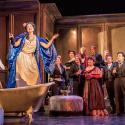
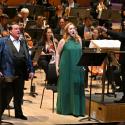
Is this the same Tatyana whose life depended on every word of her letter to straw idol Onegin at the 2009 Cardiff Singer of the World Competition? Then, Ekaterina Shcherbachenko – she’s since dropped the first “h” in transliteration – gave the most convincing, nuanced interpretation of Tchaikovsky’s famous Letter Scene, his reason for setting Pushkin’s verse-novel about youthful idealism and lost illusions. She enjoyed some success in Dmitri Tcherniakov's strangely compelling Bolshoi re-think. Now, though she looks ideally young and vulnerable, it’s all semaphoring gestures and telephone-directory phrasing – a void at the heart of a production that only fitfully delivers.
Graham Vick’s Glyndebourne Onegin, graced by the clean lines of designer Richard Hudson, its elegant stage compositions and austere focus on the three main roles, became an instant classic on its first appearance in 1994, thanks largely to the white heat of that great, sadly short-careered singing actress Elena Prokina. Unlike Vick's stupendous Birmingham big top projects, it’s never been a very deep or psychologically nuanced production, and I find it difficult to adjust to its black and white characterizations after the sorely underrated subtleties of Kasper Holten’s much-maligned Royal Opera debut.
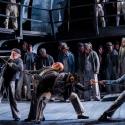
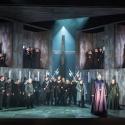
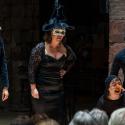
 This revival has been undertaken by Vick himself, and I’m fairly sure that his collaborator Ron Howell has added details to the choreography of country-house waltz and St Petersburg society polonaise (pictured right, the chorus in Act Three). That last is very funny where you want comedy and tragedy commingled as Onegin returns to his old stamping ground after trying to escape his guilt at the pointless murder in a duel of his best friend Lensky. It felt wrong that his first Act Three line, “here, too, I’m bored”, got a great post-champagne-and-supper laugh from the audience, though Andrei Bondarenko is charismatic enough a singer to draw us in to his predicament. The baritone sound is so handsome, the articulation always intelligent and musical, but last night he was in vocal trouble at the top, and like most of the other singers couldn’t be heard well midway back on the stage.
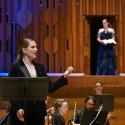
This was partly the fault of the dressed-to-impress conductor, Israeli Omer Meir Wellber: a high-profile phraser who went for boldness and dash, effective in the dances and especially the Act Two Mazurka/Cotillion. But the orchestra was too loud, especially in the final scene, and not always adjusted to the singers’ needs. There was little of the subtlety we heard from Robin Ticciati in the Royal Opera Onegin – hard, too, to adjust after his infinitely sophisticated Rosenkavalier the previous evening – and from Vladimir Jurowski when this production was last seen at Glyndebourne.
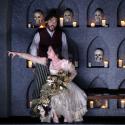
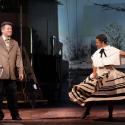
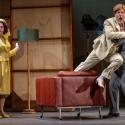
 The most meaningful intensity of the evening came from Edgaras Montvidas as young poet Lensky (pictured left). The romantic looks, the ardour, the desperation at the party where Onegin keeps grabbing his girl out of pique at local gossip, the high notes: all were as good as I’ve ever found them in a Lensky, and we’ve had many excellent tenors in the role recently. Perhaps the vibrato is rather fast, but that suits the impetuousness well.
It was unfortunate for Ekaterina Sergeeva’s rather loud Olga, his unthinking love, that Vick settled for presenting the less interesting sister at hyperactive face value (again, think of what Holten made of her). The elders, experienced Madam Larina Diana Montague and naturally plausible Nyanya Irina Tchistjakova, did all that was asked of them by Vick – not enough, perhaps – and the cameo couplets of the French tutor Triquet were elegantly delivered by François Piolino.
At least Act Two did fire on all cylinders, with the chorus excellent as throughout and the stage pictures riveting. But Act Three was defused by a woolly-voiced Prince Gremin, Taras Shtonda, over-indulged in his action-freezing aria, and by the void that was Scherbachenko’s Tatyana, making it impossible for Bondarenko to fire up the crucial final duet of dashed hopes. For those who like opera-lite, it won’t have been a disappointing evening; for the rest of us, it rarely got under the skin of Tchaikovsky’s naturalistic masterpiece.